Tuesday, 27 March 2012
The long and the short of it
A tiny round bird with a long narrow tail, rather short rounded wings and a stubby bill. The Long-tailed Tit is pinkish brown above and pinkish white below, ` a ball of fluff ` and quite possibly one of the U.K.`s most adorable birds. We are lucky in that we have had up to four of these little birds visiting our garden in Peterborough for the past few months and they show no signs of stopping with Spring arriving .
They start to make their nests in late March which are made from moss, lichen and are bound together with cobwebs. They are lined with lots of feathers. The nest is almost ` elastic ` in construction and expands when the young inside grow. Some adults that have failed to rear their young to fledging can help feed a neighbouring family, this is most common amongst the male birds.
A lovely little bird that my wife calls ` Badger birds `.
Saturday, 24 March 2012
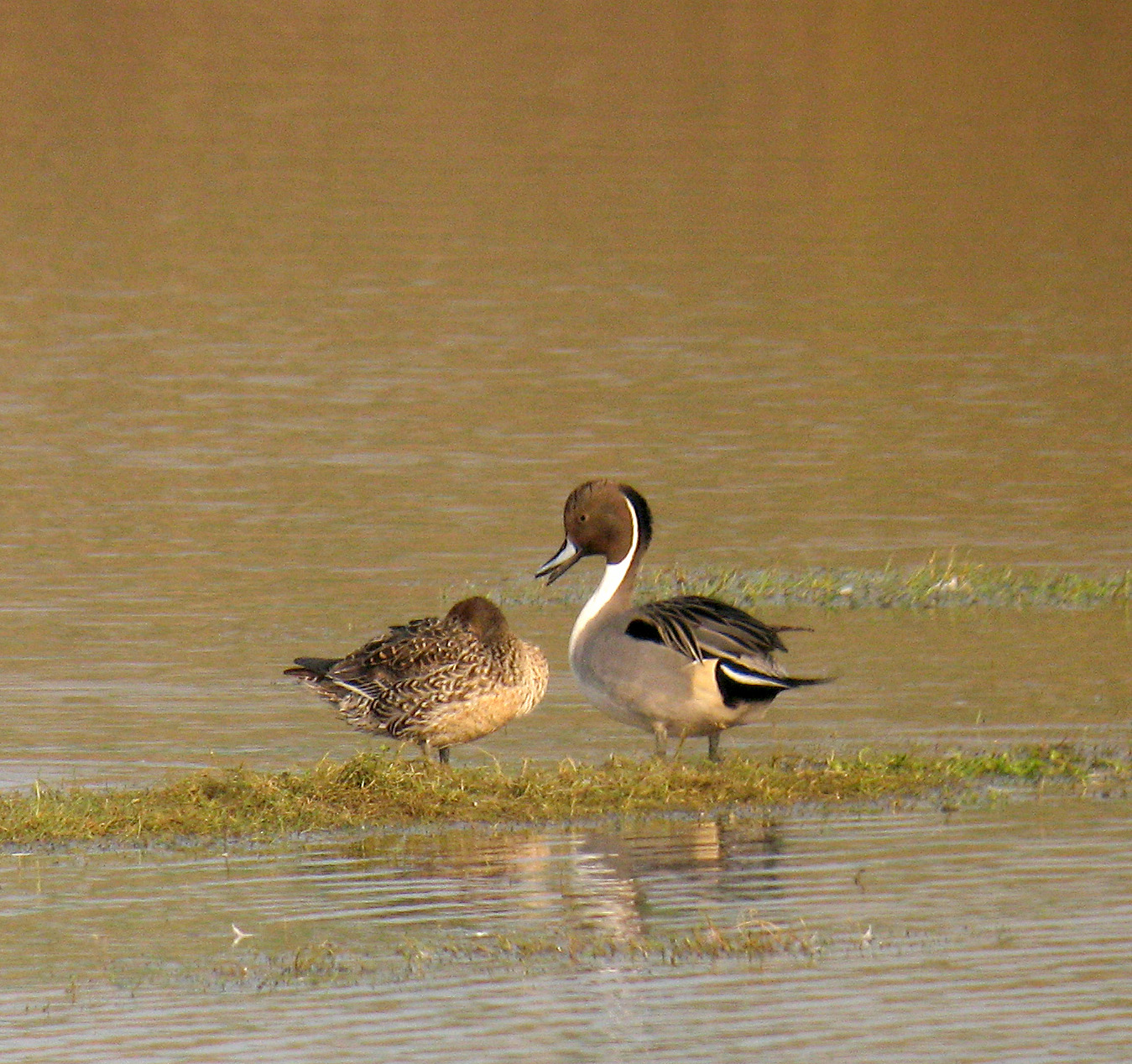
Pin the tail on the duck
These three Pintail ( 2 male and 1 female ) have been present at Maxey GP for the past couple of weeks and a starting to show signs of courtship behaviour.
The male Pintail is a stunning bird with a chocolate brown head, a finely barred grey body with long cream and black drooping back feathers. The tail is black and white with two greatly elongated black feathers, giving its `pin tail`. The female has a shorter tail and, as with most female ducks, is a mottled brown, although can be told apart by being slighly paler and greyer with a slender grey bill.
They are a rare breeding bird in Britain, with fewer than 40 pairs, although 28,000 individuals spend the winter on our shores.
Wednesday, 21 March 2012
Great Grey Shrike
Another example of `extreme` digiscoping.
A very distant record shot of my first Great Grey Shrike in the PBC area (and a heavily cropped version from the original) and an extremely good bird for my 2012 PBC year list. This bird was seen and reported yesterday evening close to the village of Thorney , just north of Peterborough and was again present today.
Mike Weedon phoned me early this morning to let me know that the bird was still present and gave me directions and after a bit of fighting with traffic and some searching with Brian Stone I managed some distant, but passable views of this stunning bird. I am hoping to return in order to get some better shots, but I leave you with these pictures as a `taster`. I only hope you can tell what it is!
Tuesday, 20 March 2012
Common or Garden
The Chaffinch is one of the most widespread and abundant birds in Great Britain, I am sure that most people are familiar with the bird. It was recorded in 93% of the 10 km squares during both recent Birding Atlases and is only scarce in Shetland and the Outer Hebrides. It is, by far the most common bird to visit our garden in Peterborough.
The male ( photos 1+3 ) has a blue/grey head, pink breast and cheeks and a chestnut back, a stunning bird and if scarcer would be one to get any birder `drooling`. The female ( photo 2 ) is a paler, drabber yellowish brown, but both sexes have the same white pattern on the wings.
The above photos were `digiscoped` in our back garden, with the photos of the male showing two different birds.
Saturday, 17 March 2012
Black and White
![]() |
| Oystercatcher |
![]() |
| Cormorant |
The Oystercatcher is a bird that is found along our coastline during the winter months, but has started to move inland to breed, where it nests on river banks, the shores of lakes and gravel pits. A bird that does not eat or catch oysters, but instead it feeds on mussels and cockles at the coast and worms inland. The population of this bird has been slowly growing during the last 50 years, although in the 1970`s it was `culled` in South Wales to protect the commercial cockle industry (this has now, thankfully stopped) and has a breeding population of around 30-40,000 pairs.
The Cormorant in the photo above looks to be of the european race sinensis which has started to colonise Eastern Britain due to the white patches on the crown and upper neck. Another bird whose fortunes are linked to commercial fishing interests, with calls being made for the bird to be `culled` due to its liking for eating fish. Whilst Cormorants undoubtedly take fish, long-term damage to commercial fish stocks has not been proven and the bird remains protected, although if fisheries can prove damage is being done they can apply for a license to shoot a limited number of these birds. The population is around 12,000 pairs.
Not everything in nature is black and white.
Thursday, 15 March 2012
Dunlin
Maxey gravel pits are my local patch, I try to get there as often as I can. Over the past few months though this site has been under water as part of a trial to see if flooding will reduce the invasive willow and so the birds present have been Black-headed Gulls and a few Teal. The pump is now on and a small amount of wader habitat is starting to appear which has brought with it some waders! This Dunlin was one of 6 present the other day (still sporting his winter garb), along with 6 Redshank, 2 Oystercatcher and 3 Common Snipe. As time goes by more invertebrate rich mud will become exposed and hopefully this will entice a few more waders to drop in.
I live in hope.
Subscribe to:
Posts (Atom)