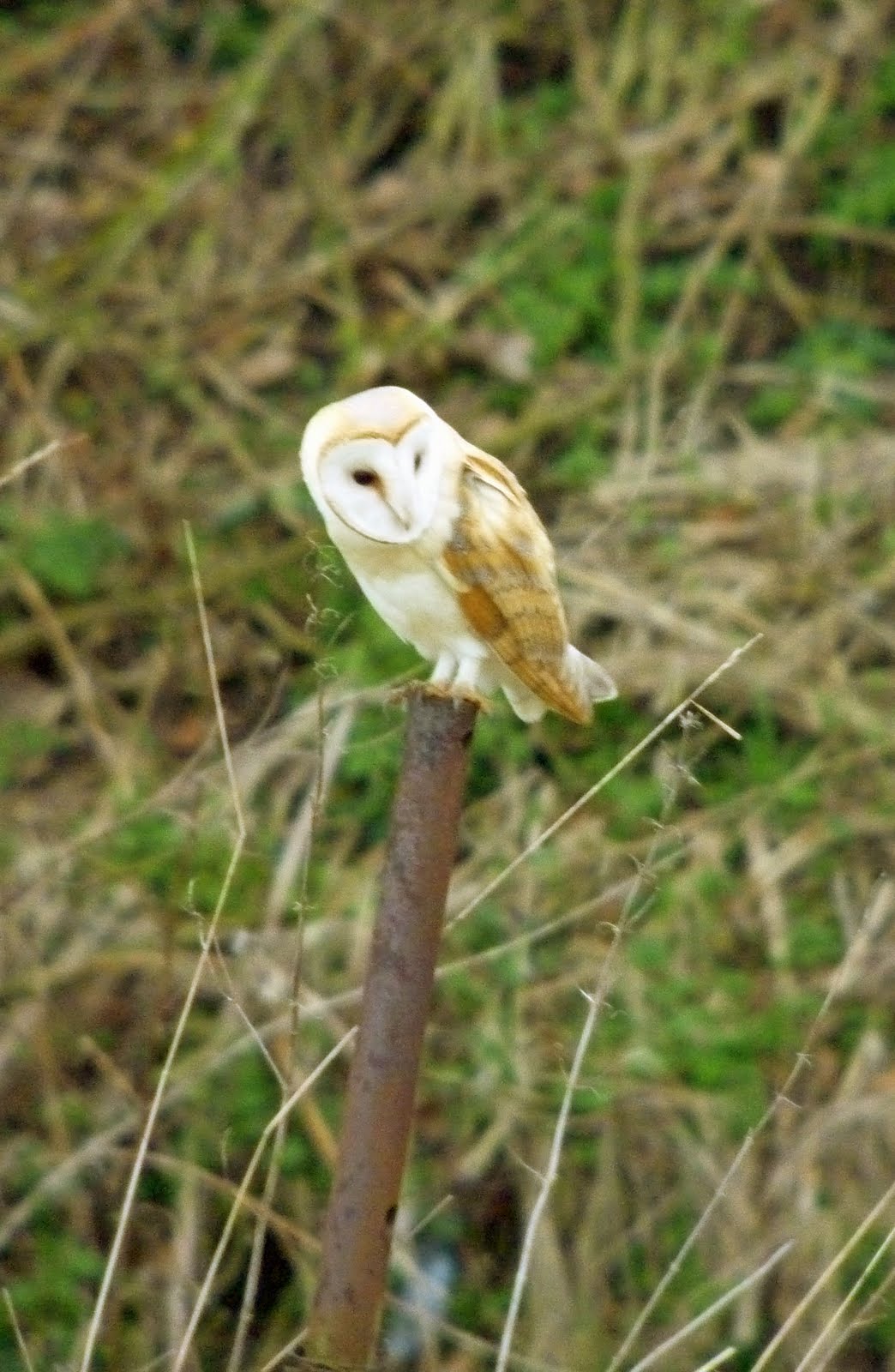
Showing posts with label Barn Owl (Tyto alba). Show all posts
Wednesday, 25 March 2015
Sunday, 15 February 2015
Barn Owl at Eldernell, Cambridgeshire
Taken on different days, but I am pretty sure they are all of the same bird that can be told from the other two Barn Owls that are present at this site by its' dark colouration on the back.
Wednesday, 14 January 2015
Barn Owl at Baston Fen
One of two birds that have been seen hunting over the small nature reserve just outside the village of Baston in south Lincolnshire. This site is pretty reliable for views of this iconic species, although numbers can vary.
Historically, the Barn Owl was probably the most common owl in Britain, but numbers have fallen from the middle of the 19th century to perhaps 12,000 pairs in the 1930's. Further declines have followed, linked with organochlorine pesticides to less than 5,000 pairs in the 1980's and to approximately 4,000 pairs in the 1990's. A recovery in numbers has occurred in some regions that can be correlated with the provision of nest boxes, suggesting that part of the decline was due to the loss of nesting sites. Weather can also play a factor with breeding success and inclement weather in the past has indeed led to the suspension of breeding, perhaps due to the poor condition of the adult birds.
Thursday, 14 March 2013
Barn Owl
The Barn Owl is thought of by many to be Britains' favourite bird, with the heart shaped face, it is certainly endearing to us. I love seeing this bird, not very easy to do any more with their population in freefall and after the disastrous 'summer' that we had last year leading to poor breeding, but at a site not far from my house in south Lincolnshire sightings are reliably had.
On the last occasion I noted at least five individuals, differing by colouration and also handy leg rings enabling me to tell that I had a different bird in my binoculars. The photos below show three individuals and also a short video of one of these hunting.
Monday, 4 February 2013
Birds in the snow
A couple of weeks ago we had some snow, not a lot, but it lasted for about a week and consequently things got a bit hard for our feathered friends.
Birds such as the Waxwing are used to harsh weather, coming from the European Tundra, but they were struggling to find the now depleted berries on which they feast. A few weeks ago these birds were everywhere, but now the reports are getting fewer and it is thought that they have moved off to Europe.
The Grey Heron is a familiar sight, but the one below looked decidedly 'miffed' at all this white stuff, curtailing his fishing exploits somewhat.
The gardeners friend, the Robin is adept at using us humans to find food, hanging around while we dig the borders and jumping down from his perch in order to grab a tasty morsel or two.
Times are hard for Owls at the moment, numbers of the Barn Owl are in freefall due to the wet summer and with snow on the ground they find it very hard to hunt.
My wife's favourite, the badger bird comes into the garden with a couple of his mates, feeds on the fatballs and is gone in a few seconds. A lot of these small birds won't survive long periods of cold.
The snow has now gone and some spring like weather has arrived. The birds are starting to sing more and several are starting to check out the nest boxes, just in time for another cold snap at the end of the week.
Birds such as the Waxwing are used to harsh weather, coming from the European Tundra, but they were struggling to find the now depleted berries on which they feast. A few weeks ago these birds were everywhere, but now the reports are getting fewer and it is thought that they have moved off to Europe.
![]() |
| Waxwing |
![]() |
| Waxwing |
![]() |
| Grey Heron |
![]() |
| Robin |
![]() |
| Barn Owl |
![]() |
| Long-tailed Tit |
Monday, 21 February 2011
More Barn Owls
Wednesday, 2 February 2011
Barn Owl
Below are a couple of photographs of a Barn Owl that I took at a place called Deeping High Bank, which is close to Peterborough and just over the border in South Lincolnshire. This site is excellent for Barn Owls and another owl, the Short-eared Owl in winter because of the `rough`, `scrubby` areas that are around the field margins that are full of field voles, the owls favourite food.
The Barn Owl is another one of our birds that has suffered a drastic fall in numbers in recent times. In the 1930`s there were believed to be 12,000 pairs, now there are only 4,000. This decline is believed to be linked to the use of pesticides and the use of second generation rodenticides. Also, the availability of nest sites is a major concern, as the old buildings that are used by Barn Owls are either being pulled down or renovated.
Re-establishing hay meadows, conserving areas of rough grassland rich in voles wherever possible, especially alongside watercourses, field edges and woods will help to ensure this species has sufficient feeding areas. The provision of nest boxes where `natural` sites have been removed is also critical.

Digiscoped using Lumix FS15 and Kowa TSN-883 x30
The Barn Owl is another one of our birds that has suffered a drastic fall in numbers in recent times. In the 1930`s there were believed to be 12,000 pairs, now there are only 4,000. This decline is believed to be linked to the use of pesticides and the use of second generation rodenticides. Also, the availability of nest sites is a major concern, as the old buildings that are used by Barn Owls are either being pulled down or renovated.
Re-establishing hay meadows, conserving areas of rough grassland rich in voles wherever possible, especially alongside watercourses, field edges and woods will help to ensure this species has sufficient feeding areas. The provision of nest boxes where `natural` sites have been removed is also critical.

Digiscoped using Lumix FS15 and Kowa TSN-883 x30
Subscribe to:
Posts (Atom)