 |
| 2 Adults and a juvenile |
Showing posts with label Whooper Swan (Cygnus cygnus). Show all posts
Showing posts with label Whooper Swan (Cygnus cygnus). Show all posts
Tuesday, 3 February 2015

Saturday, 15 December 2012
In Flight
I have been trying to get some half-decent shots of birds flying, as of now I am yet to succeed. The shots below represent the best of my efforts so far.
Hopefully, I will improve as time goes by!
 |
| A trio of Whoopers |
 |
| Three Common Cranes (2 adult and 1 juvenile) |
 |
| The same 3 Common Cranes (the juvenile is the bird on the right) |
Wednesday, 10 October 2012
Winter is here
The year is starting to wind itself up, the evenings are getting darker earlier, there is a distinct nip in the air, the leaves are turning and falling from the trees and the Whooper Swans have started to arrive.
The 'swaniest' of swans has just started to make an appearance on the local patch, not in any great numbers as of yet, but there were 19 of these lovely creatures on the River Welland today.


Just two of the nineteen on show before they all took to the air as one and disappeared into the sunset.
The 'swaniest' of swans has just started to make an appearance on the local patch, not in any great numbers as of yet, but there were 19 of these lovely creatures on the River Welland today.


Just two of the nineteen on show before they all took to the air as one and disappeared into the sunset.
Wednesday, 15 February 2012
Whooper and Bewick`s
 |
| Whooper |
 |
| Whooper |
 |
| Bewick`s |
Saturday, 11 February 2012
Flat out!
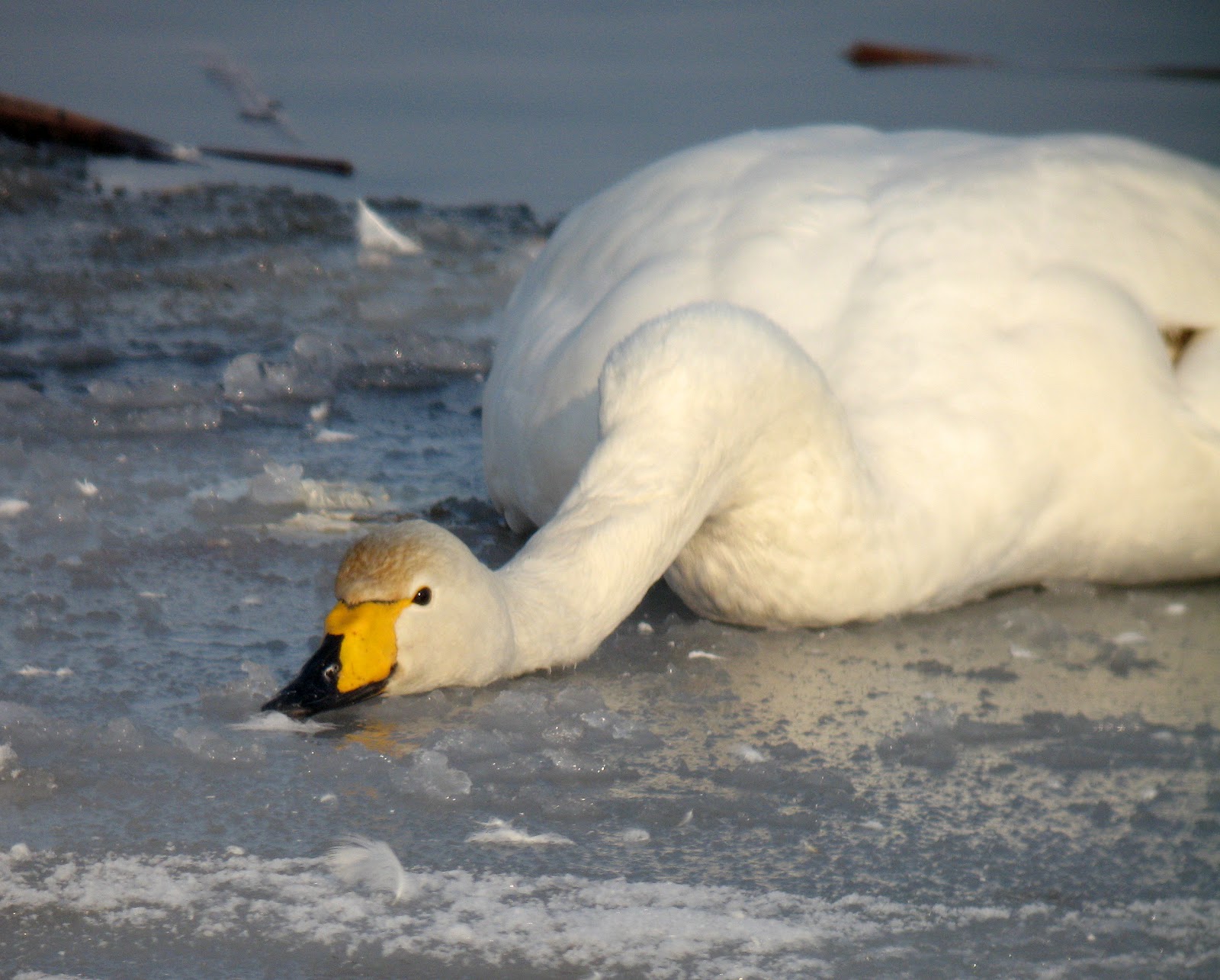
An unusual sight of a Whooper Swan just `chilling` (quite literally!) on the ice at Deeping High Bank yesterday. The river is now almost completely frozen, but the build up of birds continues.
Monday, 23 January 2012
Whooper Swan
 |
| Adult |
 |
| Juvenile |
 |
| Adult |
 |
| Adult |
 |
| Pair of adults |
 |
| Group of juveniles |
They are larger than the Bewick`s Swan, but smaller than the Mute Swan. One way to tell this bird apart from its` cousin the Bewick`s (apart from its` size) is the amount of yellow on the bill. On the Whooper this yellow extends further along the bill, beyond the nostrils, where the Bewick`s marks end before the nostrils. Although, having said that, some birds differ and have less yellow! Every birds bill markings are unique and this is used to tell each bird apart in the absence of a leg ring. You will see in the photos above that a few are of the same adult if you look at the yellow bill markings. The birds in these photos are most probably a family group as the young do stay with their parents for their first autumn and winter.
Subscribe to:
Posts (Atom)