Showing posts with label Butterflies. Show all posts
Monday, 4 July 2016
Black Hairstreak at Glapthorn Cow Pastures, Northants
The Black Hairstreak is a very localised little butterfly with a distribution which is restricted to about 45 colonies in the South and East Midlands and with having a flight period of just a few weeks makes it an elusive little creature. There are a couple of sites near me where this butterfly can be found, but until yesterday I had failed in my attempts to see one. Glapthorn Cow Pastures is a Wildlife Trust site near Oundle and is nationally known for having a colony of the Black Hairstreak, indeed people have travelled from the other end of the country to see one. The flight period is coming to the end now and so we were extremely lucky in seeing at least 5 individual butterflies still looking in pretty good nick, apart from one that was very tatty.
Monday, 3 September 2012
Blue butterflies
Two fairly 'common' blue butterflies in the Peterborough area are the Chalkhill Blue and the Common Blue. The top 3 photos show the Chalkhill (male, female, male) and the bottom 4 show the Common (female, female, male, male). These blues have a distinct difference in appearance between the sexes, with the male being the 'blue' one, while the female tends to be brown, although the Common Blue female can sometimes have more blue in the upper wing as is shown in photo 5.
This year seems to have been a good one for Chalkhill Blues with hundreds of thousands of these 'flutters' being present at individual sites. At Barnack Hills and Holes, where these photos were taken, I counted up to 450 before losing count (not thousands, but certainly good numbers). A good news story in a year when butterfly numbers have been low, to say the least.
Friday, 10 August 2012
Blue on pooh
The picture most people have of a butterfly is one perching daintily on a flower of a Buddleia or other sweet smelling plant, happily taking nectar. What you don't think of is one sitting on a pile of dog pooh, quite happily taking the salts from said excrement. It shatters the illusion somewhat, but many butterflies do it, the Purple Emperor, for example, is very fond of feeding on something extremely undesirable such as corpses of animals and also pooh of all sorts.
I visited Barnack Hills and Holes the other day and was greeted by clouds of Chalkhill Blues. There were hundreds of these lovely blue butterflies flying around in the sun and feeding on knapweeds and scaibiouses. Whilst revelling in this far too rare sight I trod in some dog pooh! Lovely, I thought, why can't dog owners clear up after their pets?! However, I was soon finding little blue butterflies coming down to feed on this 'delightful' deposit. Cleaning the foul smelling muck from my shoe, I proceeded to snap away.
I didn't see any females feeding this way, what does that say?! Shatters the picture somewhat, doesn't it?
I visited Barnack Hills and Holes the other day and was greeted by clouds of Chalkhill Blues. There were hundreds of these lovely blue butterflies flying around in the sun and feeding on knapweeds and scaibiouses. Whilst revelling in this far too rare sight I trod in some dog pooh! Lovely, I thought, why can't dog owners clear up after their pets?! However, I was soon finding little blue butterflies coming down to feed on this 'delightful' deposit. Cleaning the foul smelling muck from my shoe, I proceeded to snap away.
I didn't see any females feeding this way, what does that say?! Shatters the picture somewhat, doesn't it?
Monday, 6 August 2012
White-letter day
It has been a poor year for White-letter Hairstreaks at Bedford Purlieus, I think only a handful have been reported and up until today I had not seen one, despite my numerous visits. That was to change with the sighting of two rather tatty individuals, with one of these quite literally falling out of an oak tree and landing on some wild thyme right in front of me.
The poor creatures look decidedly worse for wear and I don't think they will last much longer, in fact, after the thunder storm that was experienced this evening I fear that they are no longer with us.
A small butterfly with a wingspan of 35mm and a fairly short flight period, with individuals normally appearing from July until mid-August. It normally feeds high in the tree canopy on honey dew, although it sometimes feeds on flowers and thistles. It is the darkest and 'plainest' of the Hairstreaks, although the uppersides of the wings are never seen as it always feeds and rests with its wings closed. This butterfly is identified by the conspicuous white 'W' on the hindwing underside.
The poor creatures look decidedly worse for wear and I don't think they will last much longer, in fact, after the thunder storm that was experienced this evening I fear that they are no longer with us.
![]() |
| The three photos above show the individual that fell out of the oak tree |
![]() |
| This is obviously a different butterfly as seen by the hindwing being in a slightly better state. |
Monday, 30 July 2012
Silver-washed Fritillaries
Got a bit carried away taking photos of these lovely flutters at Bedford Purlieus last week-end. There were at least 10 individuals, some a bit tatty, but others looked very pristine indeed. The photos below show the colour differences in the same species.
Tuesday, 24 July 2012
Marbled White
I have seen one Marbled White butterfly this 'summer' and that was at Bedford Purlieus the other day. A very obliging individual who must have been getting fed up with being photographed as there were 4 of us standing around poking lenses at it! It stayed perfectly still for about half an hour and then it obviously had enough and was off.
Getting a bit more used to the camera now, but still a way to go.
Tuesday, 17 July 2012
Butterflies
There was a strange yellow thing in the sky on Sunday and so, armed with my new camera I set out for a local wood called Bedford Purlieus to see if I could photograph some butterflies.
This wood is known for a few species, the White-letter Hairstreak, the Purple Hairstreak, the Silver-washed Fritillary and the White Admiral. Only two of these species were seen, the Silver-washed Fritillary and the Purple Hairstreak, the other two were absent, either not yet emerged or missed during the visit. There were good numbers of Silver-washed Fritillaries present, I counted at least 12 of these lovely butterflies, the largest of our fritillaries, but there were just 2 Purple Hairstreaks present, with myself seeing the one and that was thanks to a lady who kindly showed me where she had seen it cowering in the long grass. There were good numbers of Ringlets and Meadow Browns present and I saw at least 4 Commas, but the White-letters and the White Admirals were notable by their absence.
My new camera is a Canon Powershot SX40 HS, what is known as a `bridge` camera, halfway between a `point and shoot` and a DSLR. I have bought it really to use in photographing insects as I was sick of the creature flying away when approached with my little A640. I have yet to master the settings etc as I have only had it a week, but will hopefully mange a few more half-decent images in the future ( any pointers form those more experienced photographers out there would be gratefully received! ).
This wood is known for a few species, the White-letter Hairstreak, the Purple Hairstreak, the Silver-washed Fritillary and the White Admiral. Only two of these species were seen, the Silver-washed Fritillary and the Purple Hairstreak, the other two were absent, either not yet emerged or missed during the visit. There were good numbers of Silver-washed Fritillaries present, I counted at least 12 of these lovely butterflies, the largest of our fritillaries, but there were just 2 Purple Hairstreaks present, with myself seeing the one and that was thanks to a lady who kindly showed me where she had seen it cowering in the long grass. There were good numbers of Ringlets and Meadow Browns present and I saw at least 4 Commas, but the White-letters and the White Admirals were notable by their absence.
Thi Purple Hairstreak was very tolerant, crawling on to my finger and just sitting there while I took this shot!
My new camera is a Canon Powershot SX40 HS, what is known as a `bridge` camera, halfway between a `point and shoot` and a DSLR. I have bought it really to use in photographing insects as I was sick of the creature flying away when approached with my little A640. I have yet to master the settings etc as I have only had it a week, but will hopefully mange a few more half-decent images in the future ( any pointers form those more experienced photographers out there would be gratefully received! ).
Saturday, 24 September 2011
Up Close


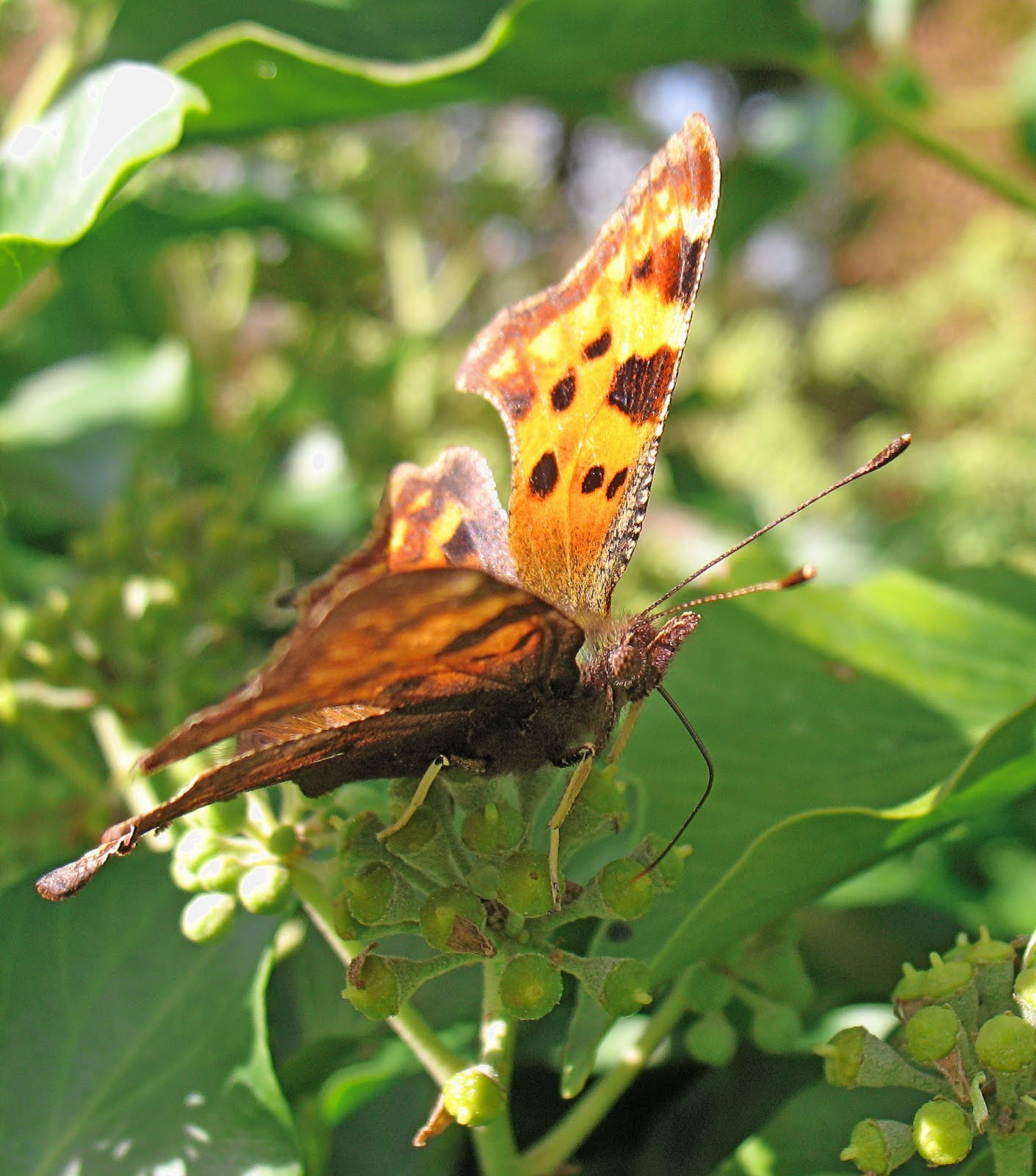
Ivy is an important plant for late flying insects. The nectar its flowers supply are a vital supply of food to these insects, especially butterflies, with the Red Admiral often being seen on this plant at, as is the Comma.
Some people consider ivy to be an invasive plant, clinging to walls and drying out mortar, thus damaging brickwork and if left unchecked can quickly swamp a flower border and even a lawn. This is true, but if managed properly, it is an extremely important plant for nature. Birds nest in it and eat the berries in winter and insects of all sorts adore it as a food source and also a home.
A vital plant for any garden worth its salt as a nature garden.
Friday, 5 August 2011
Small Copper


All photo`s hand-held Canon Powershot A640Another butterfly post, but one of a butterfly that up until recently I have been unable to photograph.
This little stunner is the Small Copper, a fairly common and widespread species. They are found in a wide range of habitats, from flowery hillsides to woodland rides and are sometimes seen in gardens. This butterfly thrives in hot, sunny conditions and in good years can have 3 or 4 broods, lasting from late April until November. In cool wet summers (this year being an example so far), the population of this lovely butterfly can crash and take several years to recover.
In East Anglia this butterfly has found it hard to survive, again due to agricultural intensification and there has been a slight decline in numbers. This butterfly has a brilliance that would be greatly missed were it to die out like the only other British butterfly with coppery wings, the Large Copper.
Saturday, 30 July 2011
True blue


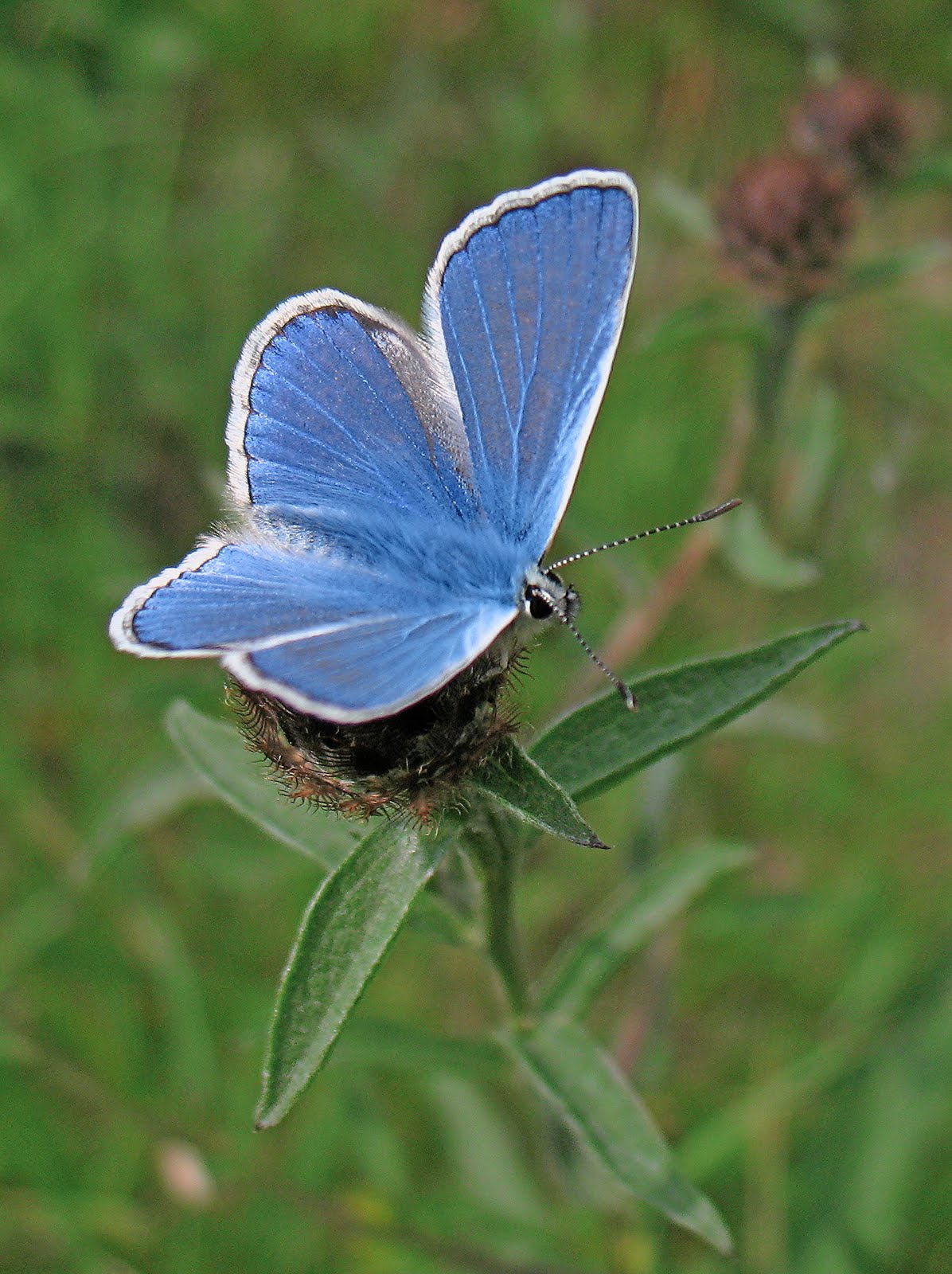
All taken using hand-held Canon Powershot A640Another `Blue` butterfly, this time the Common Blue (Polyommatus icarus). This butterfly is still a regular sight in our countryside, being our most common and widespread `Blue` species. It is found from sea level to mountains throughout Britain, although is absent in Shetland. Its` success could be due it being found in a variety of habitats, including damp meadows, heaths, woodland, roadside verges, waste ground and even suburban gardens.
It is double-brooded, with the first adults flying in May and June with the second brood flying in August and September, although sometimes this becomes blurred and the butterfly can be found in July (as in this case). The male has violet blue wings, finely edged with clear white wing margins, with the female being brown, but also has the white wing fringes, although in some areas there are blue varieties of the female with the subspecies mariscolre being particularly beautiful ( this is found in Ireland and north-west Scotland).
Subscribe to:
Posts (Atom)