Showing posts with label Rutland Water. Show all posts

Monday, 1 September 2014

Red-necked Grebe at Rutland Water


This bird has been present at Rutland Water for a few days now and has given me the chance to catch up with a bird that I have only ever seen twice before. It was hanging around at the dam end of the reservoir and showing very well amidst the gloom and damp of a fine summer evening. A bird that is more common around the coast where a few hundred overwinter each year.

Showing the difference in size and appearance to the more 'common' Great Crested Grebe.

Saturday, 12 April 2014

Pied-billed Grebe at Rutland Water


I received a phone call on Wednesday afternoon from my friend Chris Orders to inform me that a pretty rare bird had been reported from Rutland Water, a 3* mega rarity in the shape of a Pied-billed Grebe, no less! This small bird is a normally found in America, although a couple can turn up over here every year, and I had yet to add it to my life list, a twitch was on the cards!

With the evenings now drawing out that little bit more I was able to finish work, get home and ready in time for Chris to pick me up and by 6.45pm we were enjoying views of this lovely little bird, quite happily swimming around the small bay close to the sailing club. Another tick!


The Pied-billed Grebe is a little larger than 'our' Little Grebe and in breeding plumage has the obvious thick, heavy, pied bill, a giveaway if seen well. In fact, so similar are these two birds that in 1993 an adult Pied-bill paired with a Little Grebe in Cornwall and hatched three young!

Monday, 14 October 2013

Leach`s Storm Petrel

Did you miss me?!

I finally managed to get out and do some birding yesterday, the first time really since June! The bird to get me out was a lifer in the shape of a Leach`s Storm Petrel at Rutland Water, a small sea bird that is fairly scarce inland, indeed, the last time one of these birds was at Rutland was back in 1989!

The bird was seen at distance just `bobbing` around on the water, but then took flight when 2-3 Black-headed Gulls decided to mob it. I am not sure if they were trying to eat the petrel, or just took a dislike to the bird, whatever their reason, it meant that the bird was seen in flight, showing its characteristic `v`- shaped white rump and pale wing-bars.


Not the greatest picture that you will ever see, but this was the first time that I have `aired` my new DSLR, but I have only got a 300mm lens at the moment, pennies are being saved for a better and longer lens!

It was good to get out again with my friend Chris Orders and also see other birders, hopefully it won't be as long before the next trip!

(Just in case you were wondering, the petrel wasn't eaten by the gulls and was still swimming around on the lake when we left!)

Wednesday, 23 November 2011

White-rumped Sandpiper

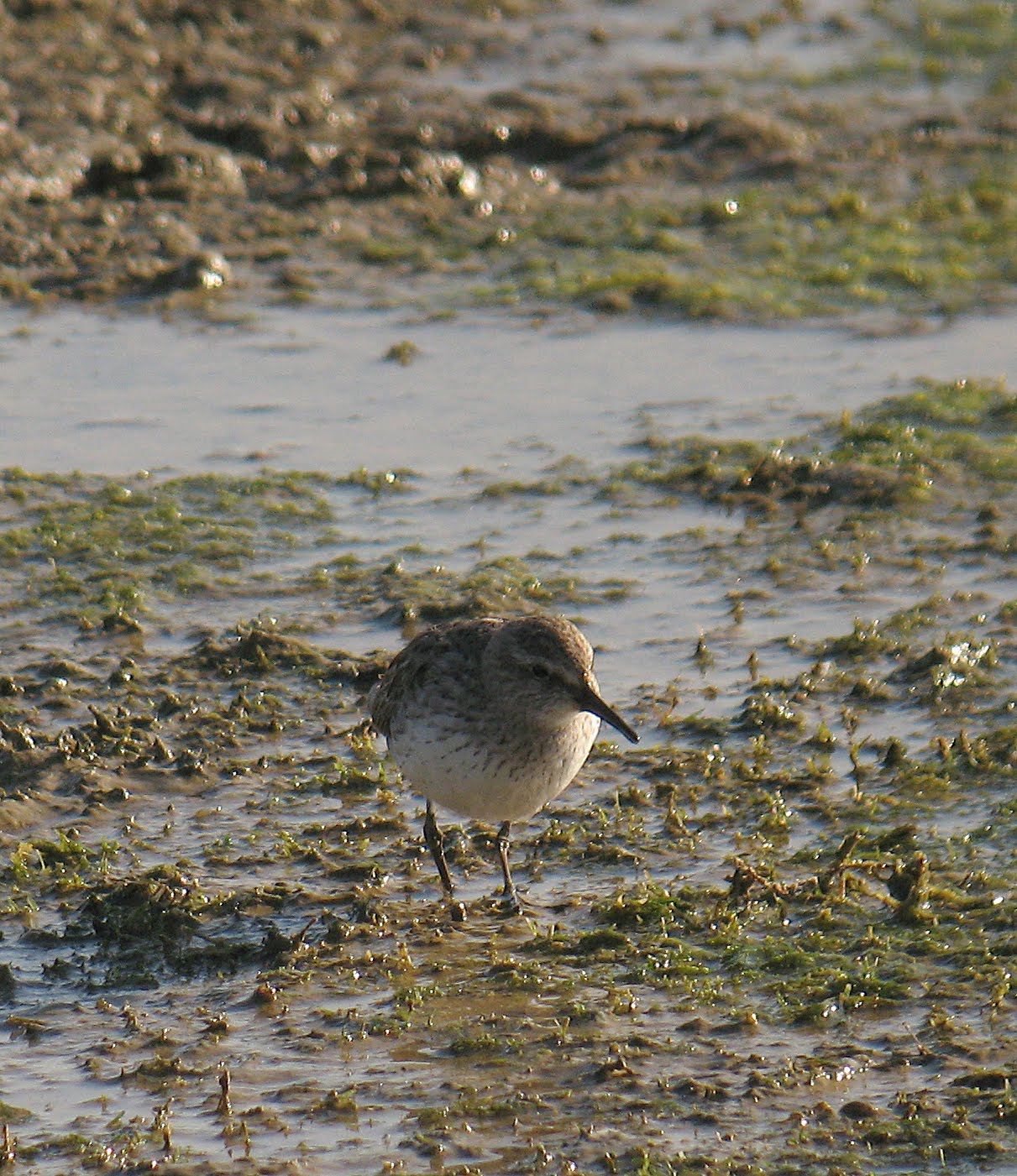
Back on the 22nd October Lisa and I paid a visit to Rutland Water to see the lingering adult White-rumped Sandpiper. The bird had been around for a few days and I saw it as a good chance of getting this wader on my British list.

On arrival at the reserve we quickly realised that we were not going to be alone in seeing this bird as the car park was full, with the overflow car park overflowing! We eventually managed to park and after paying, started our long walk to what is the furthest hide on the reserve from the visitor centre. We passed many binocular wearing and scope carrying birders who all assured us that the bird was still showing, so we pressed on.

We arrived at the rather full hide, which conveniently is quite a massive construction and were put onto the bird straight away by a very helpful birder. The sandpiper was hanging around with a group of Dunlin, which didn`t aid me in picking out the bird. To the uninitiated (i.e. me!) the birds looked pretty similar (see the last but one photo below), but after being shown the i.d. features by the same helpful birder I managed to get my eye in and was actually able to point the bird out when new arrivals came into the hide.

The White-rumped Sandpiper breeds in North America, is a little smaller than the Dunlin and has quite a bold white eye-stripe. The wings of the bird are also quite long, in fact they project beyond the tail. Also, it has a white rump, which is obvious in flight and helpfully the bird at Rutland showed all these features off rather well.

Another tick in the book!


Sunday, 24 July 2011

Curlew


The last of my postings from my recent trip to Rutland Water.

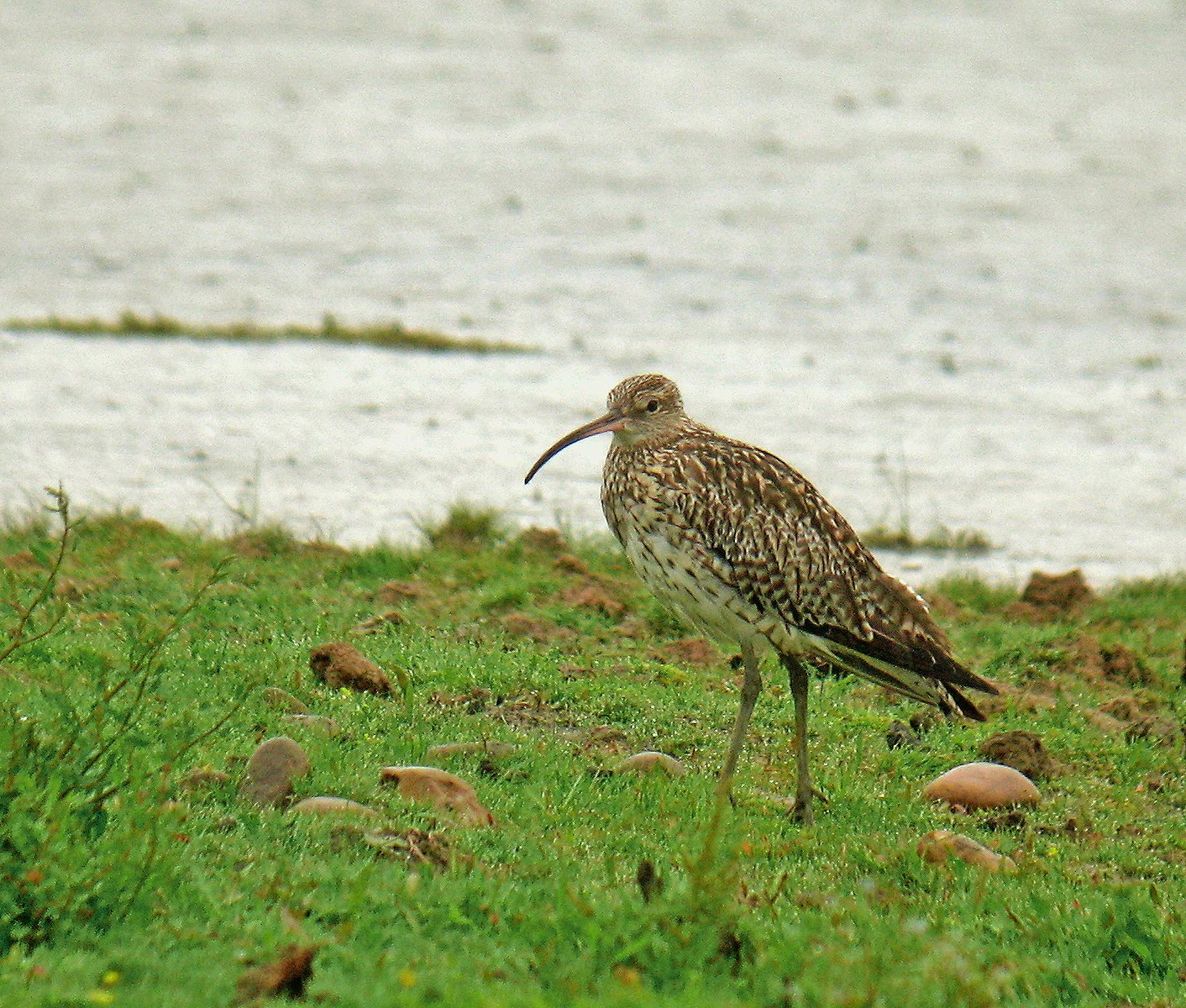
This Curlew flew in whilst I was waiting for the Spotted Sandpiper to show itself. The Curlew is a lovely bird and has beautifully intricate plumage, although some may see it as a `brown` bird!

This is one of Britains largest breeding waders and is primarily identified by its very long, deeply down-curved bill. It is a ground nesting bird, hence the plumage colouration, with up to 38,000 pairs breeding in Britain on the uplands and boggy, grassy heather moorland. The call of this bird is the evocative `cour-eee`, from which it gets its name. These birds are fairly long lived, with the oldest ringed bird being 31 years old.

Wednesday, 20 July 2011

Birds on a wire


The above photo`s were Digiscoped on my recent visit to Rutland Water and is a small sign that the Sand Martin colony there has had a fairly successful breeding season. The birds in the pictures are pretty much all juveniles and could be from different colonies from the surrounding area as these birds tend to gather in these mixed groups before making their long trip to Africa in August.

This bird is one of our earliest migrants, with birds arriving in March. They are smaller than a Swallow and slimmer than a House Martin, with brown upperparts and white underparts with a distinct brown band across the breast (a feature that helps tell it apart from the similar House Martin when the colours cannot be seen well). They breed in colonies and depend on vertical sandy banks for nesting. These sites tend to be close to rivers and sand/gravel quarries. They happily use man-made nest sites in areas where their natural choice is limited and perhaps this has enabled their population to stabilise after a massive crash in 1984. The population in the U.K. is estimated to be in the region of 250,000 pairs, although the bird is found throughout most of Europe, Asia and North America.

Sunday, 17 July 2011

Spotted Sandpiper


Back to birding with a spot of `twitching` yesterday.

This Spotted Sandpiper has been present at Rutland Water for the past few days, but with work commitments I have been unable to visit. Rain scuppered my plans for working yesterday and so with the bird being reported early in the morning I decided to brave the weather and get this `lifer`!

After a rather long walk, in what can only be described as torrential rain, I arrived at the hide that the bird had been seen from. I entered and was kindly put on to the bird by a young lad who was watching it through his scope, I was rather less than enamoured with the view as the bird was at least 500m away! (This bird is the size of a Starling, so is rather small). However, I duly `ticked` and settled in to wait to see if the bird came any closer. The hide gradually filled, the rain got heavier and the bird stayed where it was. Eventually, it flew, but no-one saw where to, so I decided to watch the family of Ospreys that were putting on a little show, obviously annoyed at all these birders paying them no heed. Half an hour went by, the conversation in the hide started to become slightly negative to say the least and I was about to leave, happy in adding 1 more tick in my book, when on a last scan of the area I noticed the Spotted Sandpiper standing approximately 40-50 metres in front of the hide giving fantastic views! After informing everyone I watched and Digiscoped this bird for approximately 20 minutes while it fed quite happily infront of the now happier crowd. It put on a fantastic show, showing its spots off to the full and then flew to the far bank where it remained.

This little wader breeds in North America and is a fairly regular vagrant to Britain with annual records, indeed a pair attempted to breed in Scotland in 1975, but this was unsuccessful. It is related to `our` Common Sandpiper and out of its spotted finery in the winter it is very difficult to tell them apart. Luckily, this bird was all spotty and very obviously a Spotted Sandpiper.

Tuesday, 26 April 2011

Walk like an Egyptian


Digiscoped using Canon Powershot A640 and Kowa TSN-883 x30


The Egyptian Goose is thought to have been introduced into Britain from South Africa in the late 1700`s and by the 1960`s there was a small population in Norfolk which has grown and expanded into new areas. Numbers are increasing at Rutland Water (where these photo`s were taken) and they are now colonising several midland counties, including Nottinghamshire and Derbyshire.

Egyptian Geese are larger than a Shelduck, with long pink legs and a small pink bill. They are buff coloured with a reddish-brown back, pale grey underparts and have a dark mark on the breast. The head and neck are paler, with a brown patch around the eye and there is a narrow neck band. The wings are dark with a green speculum and an obvious white wing patch.

There are estimated to be around 1,000 individuals of this species, with 700 of these thought to be breeding adults. The population is thought to be increasing rapidly. In Africa this bird is widespread south of the Sahara Desert and also on the upper Nile in Egypt.

Thursday, 16 December 2010

Tree Sparrow

Below are some photo`s of a couple of Tree Sparrows taken at Rutland Water. This little brown bird has had it quite hard over the past few decades, but thankfully here in Peterborough and the surrounding area we have a few thriving populations.

It is slightly smaller and `neater` with a more rounded head than the more familiar House Sparrow. It has a pale collar around the back of the neck, a chocolate brown cap with no grey on the crown and a small isolated dark patch on the cheeks. It also has a double white wing-bar, although this can be difficult to see. Both male and female look alike.

The Tree Sparrow is rather shyer than the House Sparrow and in Europe it is less associated with humans, although in parts of Asia it is common around houses.

The species is mainly sedantry, especially in Britain, but some that breed in northern Europe and Russia do make short migrations with some Conitinental birds crossing the North Sea to reach Britain in autumn and return in spring.

As I said at the beginning this bird has suffered lately with latest figures showing a decline of over 80% in the last 25 years, the biggest of which occured in the 1970`s and 80`s. This decline appears to be linked to intensification of agriculture, especially autumn sowing of crops which reduces the number of stubble fields, on which the birds like to feed and also the use of herbicides and pesticides. The clearance of hedges and trees have also made the survival of winter more difficult. Thankfully there are a few farmers which have halted this decline by changing their farming practices, one of which is Vine House Farm in Deeping St.Nicholas near Peterborough. Others will hopefully join in.


Saturday, 11 December 2010

American Wigeon

Below is what is commonly known as `a record shot` of a drake American Wigeon, latin name Anas americana, or as I call it, a rubbish distantly taken photo of a drake American Wigeon! This handsome bird has been at Rutland Water for the past couple of days and as its` name suggests is a rare straggler to these shores from America.

Every year there are approximately 10-20 records of this species in Britain, but this is the first time I have seen one, what is known as a`lifer`. While I was at Rutland Water there were also 5 Smew, 3 Goosander and a Red-breasted Merganser plus a lot of more common wildfowl, but the american was what I went for and now I can put another `tick` in my book!


Digiscoped using Lumix FS15 and Kowa TSN-883 x30


And now a break from normal proceedings to announce that my humble blog has been presented with an award from my friend Gary. It is the `Honest Scrap` award;


Apparently I am now supposed to tell you some facts about myself, but as I am extremely dull and ever so humble, I have found this a bit difficult! Here goes anyway!

1. I do not follow football (soccer). I know this is extremely hard to believe, being male and English, but I just find it dull and the hype that surrounds it is awful! No-one was happier than me when England failed to land the World Cup!
2. I don`t like to see birds in cages. Birds were given wings for a reason and I don`t think that reason is to be shut in a cage!
3. I hate flying, it makes my arms tired! Ha Ha! Seriously, I don`t like flying!
4. I am an uncle to two fantastic children, Olivia and Harry. Great kids, who I am trying to educate in the ways of Birdwatching! (unsuccessfully at the moment)
5. I once played cricket with an England international and a New Zealand international.

There you go, five facts and now to pass this award on to others.

1. The Blogger Formerly Known As.... who started me on this blog adventure and is a constant source of advice, plus I think this is one of the few awards that they have yet to receive!
2. The Whimsical Gardener who takes fantastic photographs of amazing places.
3. Mustang Sally who is also a fantastic photographer.

I would like to pass this on to Bazza, but he has mentioned that he no longer wishes to accept awards, so I just thought I would provide a link anyway!