Showing posts with label Waxwing (Bombycilla garrulus). Show all posts
Tuesday, 17 March 2015
Waxwing
Waxwings have been a bit thin on the ground this winter, but with one turning up at not too far off Corby, I decided to pay a visit on Sunday before seeing my Mum for Mothers' Day.
The bird had been seen in what is quite a usual spot for Waxwings, an industrial estate/retail park, frequenting a hawthorn tree just outside a pub. On arrival the bird was nowhere to be seen, but within 10 minutes it was showing remarkably well in said tree, feeding and even calling at times. The weather and light were dull and dreary, but I managed a few photos of what was my first bird of this species since the 'invasion' a couple of years ago.
Tuesday, 12 February 2013
Monday, 4 February 2013
Birds in the snow
A couple of weeks ago we had some snow, not a lot, but it lasted for about a week and consequently things got a bit hard for our feathered friends.
Birds such as the Waxwing are used to harsh weather, coming from the European Tundra, but they were struggling to find the now depleted berries on which they feast. A few weeks ago these birds were everywhere, but now the reports are getting fewer and it is thought that they have moved off to Europe.
The Grey Heron is a familiar sight, but the one below looked decidedly 'miffed' at all this white stuff, curtailing his fishing exploits somewhat.
The gardeners friend, the Robin is adept at using us humans to find food, hanging around while we dig the borders and jumping down from his perch in order to grab a tasty morsel or two.
Times are hard for Owls at the moment, numbers of the Barn Owl are in freefall due to the wet summer and with snow on the ground they find it very hard to hunt.
My wife's favourite, the badger bird comes into the garden with a couple of his mates, feeds on the fatballs and is gone in a few seconds. A lot of these small birds won't survive long periods of cold.
The snow has now gone and some spring like weather has arrived. The birds are starting to sing more and several are starting to check out the nest boxes, just in time for another cold snap at the end of the week.
Birds such as the Waxwing are used to harsh weather, coming from the European Tundra, but they were struggling to find the now depleted berries on which they feast. A few weeks ago these birds were everywhere, but now the reports are getting fewer and it is thought that they have moved off to Europe.
![]() |
| Waxwing |
![]() |
| Waxwing |
![]() |
| Grey Heron |
![]() |
| Robin |
![]() |
| Barn Owl |
![]() |
| Long-tailed Tit |
Wednesday, 16 January 2013
Peterborough Waxwings
Waxwings are still present in the Peterborough area. Some have been hanging around at Ferry Meadows CP (I counted 19 when I visited yesterday) and a bigger flock have been present in the village of Werrington.
The Werrington flock were seen from a garden in which I was working today, the lady whose garden it was told me that that she had seen them from her back garden since before the New Year, with numbers fluctuating, but mostly in the late teens. This flock duly appeared in its' favoured tree, but I counted at least 40, bigger than was first thought. I was able to pop back later in the afternoon when I had finished my jobs for the day and was surprised at how large the flock had grown. The numbers in these flocks are really hard to gauge with the naked eye, despite numerous counts and so I took a ropey photo of the flock and was amazed at the total! The photo is below, have a guess before counting them, I think you will be as surprised as me when you actually count them (or maybe not!).
The birds at Ferry Meadows CP were seen in far better light yesterday, which enabled me to get some fairly good close-ups, although I leave the final judgement to you, dear reader. As always, click on the images for a larger picture.
The Werrington flock were seen from a garden in which I was working today, the lady whose garden it was told me that that she had seen them from her back garden since before the New Year, with numbers fluctuating, but mostly in the late teens. This flock duly appeared in its' favoured tree, but I counted at least 40, bigger than was first thought. I was able to pop back later in the afternoon when I had finished my jobs for the day and was surprised at how large the flock had grown. The numbers in these flocks are really hard to gauge with the naked eye, despite numerous counts and so I took a ropey photo of the flock and was amazed at the total! The photo is below, have a guess before counting them, I think you will be as surprised as me when you actually count them (or maybe not!).
The birds at Ferry Meadows CP were seen in far better light yesterday, which enabled me to get some fairly good close-ups, although I leave the final judgement to you, dear reader. As always, click on the images for a larger picture.
![]() |
| The flock in Werrington. How many can you count? |
![]() |
| One of the Werrington flock |
Saturday, 29 December 2012
Waxy apples, Part 3
It's raining, no surprise there, so to remind us of what sunny weather and blue skies look like, the final few photos of Waxwings from a few weeks ago.
I promise that there won't be any more, not this year anyway!
Friday, 21 December 2012
Waxy apples, Part 2
The world didn't end this morning at 11.11, so to celebrate, here are some more photos of the Waxwings from Tuesday. I hope you are not getting tired of Waxwing photos, because there may be more.
Wednesday, 19 December 2012
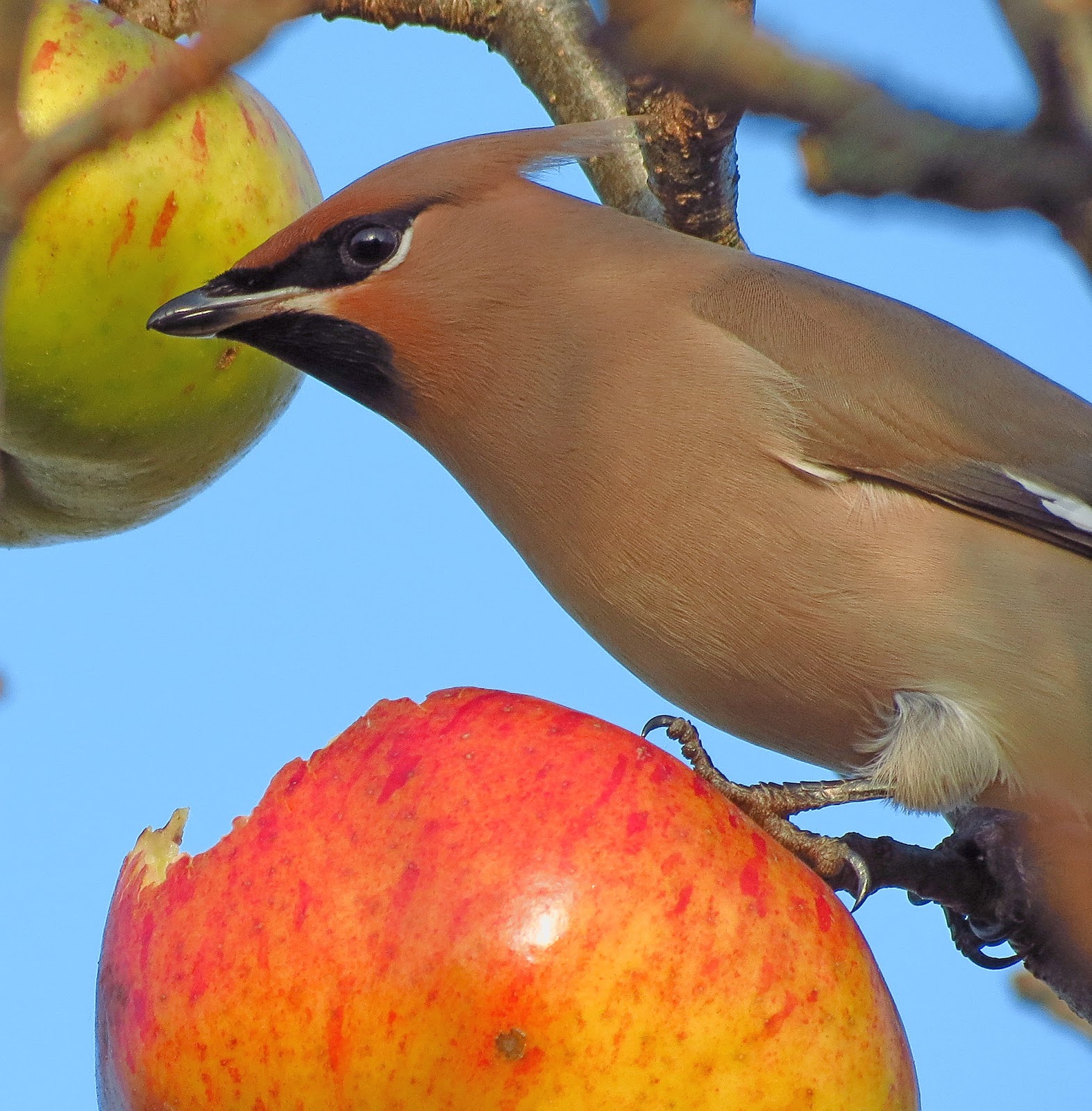
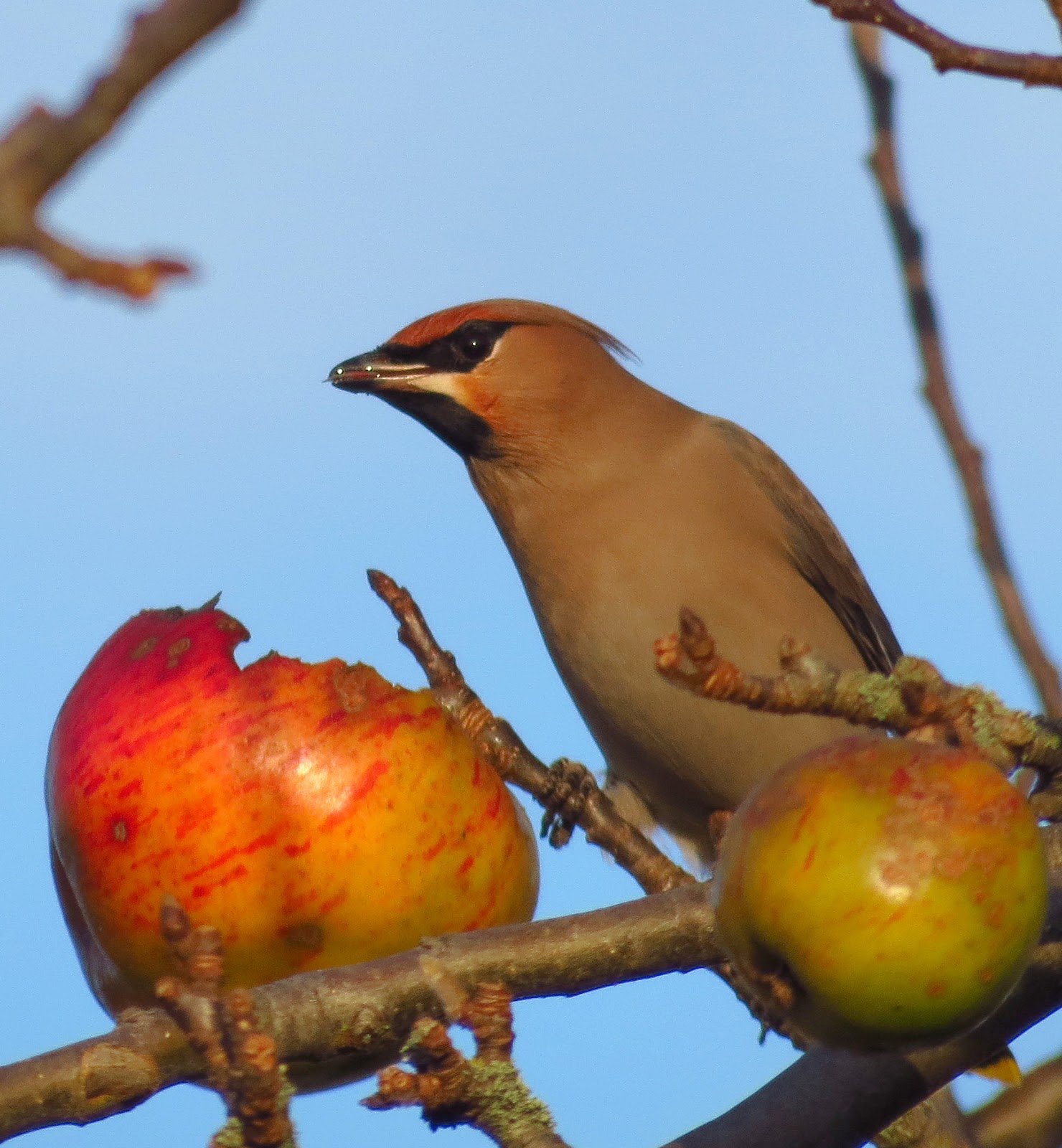
Waxy apples
I found these very obliging Waxwings feeding on apples in a front garden in Werrington yesterday. The owner of the house was very very accommodating, allowing myself and Mike Weedon to take some photos.
These are the first of a few that I took, more will follow.
Wednesday, 12 December 2012
Upside down Waxwings
Just a few from the huge flock that were at The Crab and Winkle pub in Werrington last week. More will follow!
Tuesday, 4 December 2012
Waxwing in the hand
This post is not what it first appears. It is sad and contains photos of a beautiful bird that some people may find distressing, so if you are at all squeamish please do not read any further.
Another large flock of Waxwings has appeared in the Peterborough area and once again I found myself camped by some Rowan trees waiting for these 'trillers' to come and feed so I could take yet more photos. The birds have descended upon an area very close to my house in the village of Werrington, the same area that a flock of up to 140 appeared in the last mass irruption year of 2010/11 and an area quite close to a busy road.
There I was, waiting patiently when a couple of other birders arrived. This couple then noticed a dead bird on the side of the road that I had not seen, which turned out to be a Waxwing. Very sad, to come all this way and be hit by a car. It did, however give us a chance to see the bird 'up close', marvelling at the plumage and of course, the red 'wax' tips of the secondary feathers that give the bird its' name.
Brian Stone arrived and we both looked at the bird, trying to see if we could sex or age it, but we couldn't. On return to his office Brian e-mailed me a link which showed the differences in the sex and age of the Waxwing. Click HERE if you wish to look at this link yourself (this has photos of live Waxwings, so nothing nasty). After perusal of this link I have come to the conclusion that the bird was a juvenile male bird, judging from the lack of yellow on the outer web of the primary feathers and the number of red 'wax' tips being five with the longest being 5.5mm. The birds' markings under the throat had a diffuse edge, but that is surely due to it being a juvenile, although I am not sure.
Below are some photos of the bird, showing some of the markings that I have explained above. WARNING, these are of a dead bird, although the bird is not deformed or marked in any way, it is dead, so please do not view if you are offended.
A sad end for a beautiful bird, but a fascinating chance to have one so close, I just wish that I could have released him to fly again.
Another large flock of Waxwings has appeared in the Peterborough area and once again I found myself camped by some Rowan trees waiting for these 'trillers' to come and feed so I could take yet more photos. The birds have descended upon an area very close to my house in the village of Werrington, the same area that a flock of up to 140 appeared in the last mass irruption year of 2010/11 and an area quite close to a busy road.
There I was, waiting patiently when a couple of other birders arrived. This couple then noticed a dead bird on the side of the road that I had not seen, which turned out to be a Waxwing. Very sad, to come all this way and be hit by a car. It did, however give us a chance to see the bird 'up close', marvelling at the plumage and of course, the red 'wax' tips of the secondary feathers that give the bird its' name.
Brian Stone arrived and we both looked at the bird, trying to see if we could sex or age it, but we couldn't. On return to his office Brian e-mailed me a link which showed the differences in the sex and age of the Waxwing. Click HERE if you wish to look at this link yourself (this has photos of live Waxwings, so nothing nasty). After perusal of this link I have come to the conclusion that the bird was a juvenile male bird, judging from the lack of yellow on the outer web of the primary feathers and the number of red 'wax' tips being five with the longest being 5.5mm. The birds' markings under the throat had a diffuse edge, but that is surely due to it being a juvenile, although I am not sure.
Below are some photos of the bird, showing some of the markings that I have explained above. WARNING, these are of a dead bird, although the bird is not deformed or marked in any way, it is dead, so please do not view if you are offended.
![]() |
| Showing how small the bird is, smaller than a Starling. The ruler is 15 cm or 6 inches long. |
![]() |
| Showing the diffuse edge of the black 'bib' under the throat. |
![]() |
| The red 'wax' tips on the secondary feathers with the tips of the outer webs of the primary feathers being yellowish-white and no markings on the inner webs. |
![]() |
| The head of the bird, showing the slight diffuse nature of the black 'bib'. |
Sunday, 2 December 2012
Thursday, 15 November 2012
Bourne Bohemians
Another Waxwing post I am afraid.
These birds were first reported on Wednesday by Josh Jones, whose Mum had seen them from her office window on an industrial estate in the small town of Bourne in Lincolnshire. She initially reported 3, but on my arrival I managed to count 12, but this quickly turned into 21! The birds seemed very nervous and flew at the slightest noise and movement, most unlike typical Waxwings. They were feeding on Rowan and Hawthorn berries, but were also 'fly-catching' from the top of a Sycamore tree, behaviour that has been present in all the Waxwings that I have seen so far this year. It is still fairly mild and with the presence of insects the birds are taking full advantage in order to get a mixed diet.
As can be seen from the photos, the sun was a little bit shy, to say the least, but I am sure there will be more opportunities this winter, one which looks like another 'irruption' year for this crested wonder.
These birds were first reported on Wednesday by Josh Jones, whose Mum had seen them from her office window on an industrial estate in the small town of Bourne in Lincolnshire. She initially reported 3, but on my arrival I managed to count 12, but this quickly turned into 21! The birds seemed very nervous and flew at the slightest noise and movement, most unlike typical Waxwings. They were feeding on Rowan and Hawthorn berries, but were also 'fly-catching' from the top of a Sycamore tree, behaviour that has been present in all the Waxwings that I have seen so far this year. It is still fairly mild and with the presence of insects the birds are taking full advantage in order to get a mixed diet.
As can be seen from the photos, the sun was a little bit shy, to say the least, but I am sure there will be more opportunities this winter, one which looks like another 'irruption' year for this crested wonder.
Subscribe to:
Posts (Atom)