Yesterday the whole country seemed to have Little Gulls passing through. We had a fair share in the Peterborough area with a couple at Ferry Meadows CP, 7 reported at Deeping lakes and at least 5 at Maxey/Etton pits, where I managed to take the above images. At least 3 of the Maxey birds seemed to be in full summer plumage, a stunning bird with an all black hood, black bill and a slight pink tinge to the breast, which is hopefully obvious in a couple of the photos.
A nice addition to my PBC year list which is chugging along nicely with a fairly healthy total of 149 as of writing. This Avocet was present yesterday evening at Maxey GP, but had vanished this morning. Obviously just passing through.
These beautiful birds are getting as scarce as hens' teeth these days. Reasons are varied - habitat loss, systemic weed killers, agricultural intensification, to name a few, but my personal belief is one of hunting. These stunning birds are being blasted out of the skies as they make their migration across the Mediterranean to our shores in order to breed. They are killed before they are have a chance to further the species on islands such as Malta, the reason........ 'Sport'.
Another trial with the new camera. This time with a bird that has been hanging around the local area for a while now, but time constraints have meant that I have been unable to catch up with this large white heron. That changed on Monday, with the weather being awful and so, not conducive to gardening and with the bird being reported from Maxey, my local patch.
It was first seen on the Maxey Cut, in the company of a couple of Little Egrets, but then flew to the adjacent field, where it stood and preened for a while. It then took flight and went out of view.
Again, not the greatest, but a `record` shot of this addition to my PBC year list.
I have never seen a Clouded Yellow butterfly in this country before and so I was quite shocked and a little excited to see one of these lovely flutters at Maxey GP the other day whilst having a stroll after work.
A butterfly that is a regular migrant to our shores, with numbers each year varying form just a few to several hundred. Not sure if this is a 'Clouded Yellow Year' or not, but there have been a few sightings around the east of the U.K.
With reports of a couple of Wood Sandpipers being present at my local patch of Maxey gravel pits, I managed to grab a couple of hours on Sunday to go and see if I could get a view of a wader that I have not seen locally for at least a year.
This site is looking rather good at the moment and with my first scan of the area I managed to see the first Wood Sandpiper, huddled down in the company of a Common Sandpiper. Continuing my perusal of the site I picked up the second Woody, fairly close by and also 3 Dunlin, 8 Green Sandpipers, 3 Ringed Plovers, 1 Little-ringed Plover and another 2 Common Sandpipers.
On walking back to the van, it was good to note that there were fairly large numbers of Common Blue butterflies present.
Two small, brown birds. Both come to Britain in the summer months in fairly large numbers in order to breed. They like spending their time in reed beds or thick undergrowth and they both have pretty similar songs.
Reed Warbler
Sedge Warbler
Below is a short video of the two birds in question, hopefully showing the difference in the two songs. The first bird is the Reed Warbler, a song which is 'chatty' and slow paced, consisting mostly of jittery notes which are repeated 2-3 times, interrupted by occasional mimicry or whistles. The second is the Sedge Warbler with a Reed Warbler in the background, this song is a series of long, loud sequences of not very varied excited notes relieved by rapid cascades of trills and whistles and occasional mimicry.
Back to my normal sub-standard of photography today with a record shot of a truly stunning bird seen at my local patch of Maxey gravel pits for a whole 15 minutes, before it flew off, not to be seen again.
This summer plumaged Spotted Redshank was a welcome addition to my PBC year list which has now limped to 166, but does include 2 local lifers as well as some rather scarce local birds, such as the aforementioned Spotted Redshank. A bird that I have only seen twice before in the local area and not for a couple of years, so this was a very welcome sighting.
A bird that is more easy to hear than see. A skulking small, brown bird that comes to this country in the summer months to breed and spends the winter months in sub-tropical Africa.
A bird that I have never really been able to photograph well due to its habit of staying in dense reed beds. That has now changed.
It's a shame that in the bottom photo the bird is facing away from me, but I am quite pleased with the results. These two photos are crops of the originals, which are below. I put my fieldcraft `skills` into good use with this bird, hearing and seeing it first and then sitting still and waiting for the bird to come to me. At times he was less than 3 feet away, singing and just perched.
As always, click on the photos for a larger image.
It must be something to do with Wednesdays. Last week there were two of these superb little birds at my local patch of Maxey pits, but they were gone on Thursday morning. Today, another one of these birds was present, constantly distant and always on the move. I wonder if he will be there tomorrow?
Maxey is looking pretty good at the moment for a nice wader or three, the water levels seem to be under control and so there is a lot of mud exposed, just waiting for something to drop in. As well as the Whinchat, this morning there was a Grey Plover in almost full breeding plumage, a scarcity in these parts, although it was my third one of this year. Always a nice bird to see though, especially in their breeding finery.
It's been a while coming, but finally the summer migrants are making their way onto our shores. The cold weather has seemingly delayed birds such as Swallows, House Martins, Redstarts, Ring Ouzels and Wheatears, to name a few, from making their way to Britain for the summer months, but now these are all coming, in their droves!
The past couple of days have been a bit crazy in the Peterborough area, with several Redstarts being seen, we are lucky to see more than a couple in the Spring, but this year up to 8 individuals have been present in various sites. Common Terns have started patrolling the lakes at Ferry Meadows and Deeping and huge numbers of Wheatears have been present at a couple of locations. 14 of these birds were seen in a field close to the village of Yaxley and yesterday there were 17 in a field close to the village of Ailsworth where there was also the only Ring Ouzel to be reported so far this year.
At Maxey/Etton gravel pits there were 3 Wheatears present (the male in these photos), a female and a Greenland type male. Also present were up to 6 Yellow Wagtails with one showing signs of being from the flava race, or Blue-headed Wagtail if you prefer and a Common Sandpiper.
This Little Owl tends to be found in the same tree day after day, month after month and, as it turns out, year after year. The tree is close to the site of Maxey Gravel Pits and I have managed to see the owl in said tree for the past three years.
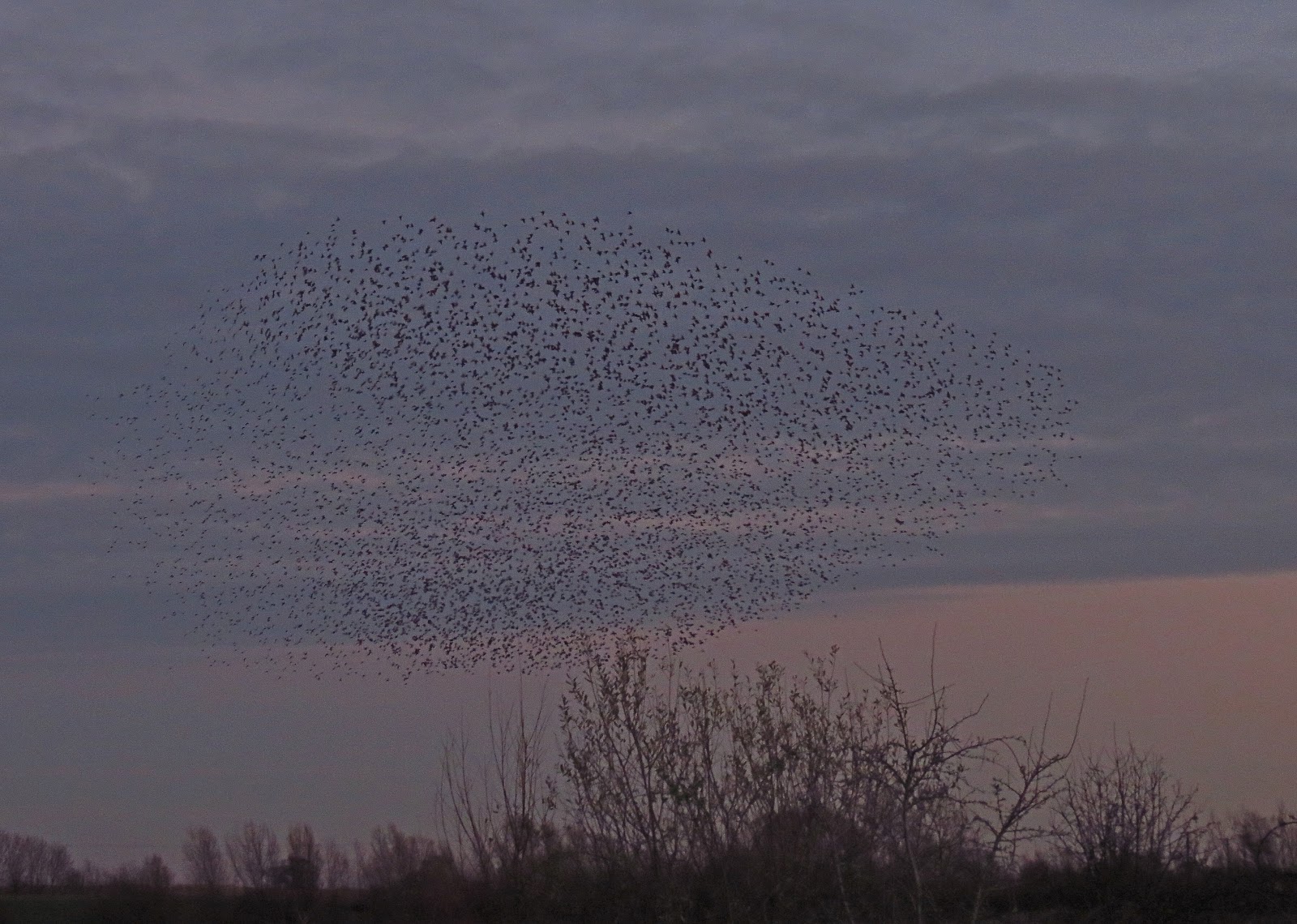
One of natures' spectacles in the winter months is surely that of the flocks of Starlings going to roost, the 'whirling' patterns of thousands of birds as they perform a ballet of true wonder and beauty.
In the Peterborough area we have a couple of these roosts at the moment, one at Deeping Lakes and one at Maxey gravel pits. Both number thousands of birds, but it was at Maxey that I found myself this evening. A few other local birders had also come to view the spectacle and as the numbers of birds grew and grew we were all left speechless, well, almost!
The final estimate was anything between 10-15,000 birds.
Below are a couple of short videos, not the greatest pieces of camera work you are ever likely to see and there are a couple of 'voices off', but hopefully they will give you an idea of what was on offer.
These numbers do give a slightly false impression of the state of Starling numbers at the moment. This year alone, over 40 million of these birds have vanished in Europe. No one knows the cause, but changes in agricultural practice are being mooted as one of the prime reasons. One thing is for sure, if something is not done to reverse the catastrophic fall in numbers of this bird, sights like those above will be a thing of the past.
Winter may be appearing on the horizon (see previous post), but dragons are still hanging on and in evidence when the sun is shining. They are a little more sluggish with the cooler temperatures, perching more often and for longer periods, allowing me to get fairly close and get these head shots.