Showing posts with label Dragonflies. Show all posts

Saturday, 10 September 2016

Willow Emerald Damselfly at Kings Dyke NR, Cambridgeshire

Note the obvious 'spur' marking on the thorax. A key feature of this species

You can just about make out the pale wing spots, or pterostigma, another key feature

A damselfly with very few 20th century records in the U.K., but first seen in regular numbers in Suffolk in 2009. This species has been steadily moving eastwards over the past few years and has now been sighted in the Peterborough area on at least two occasions, one of which being the sighting that I had at Kings Dyke nature reserve a few weeks ago.

Not being a dragonfly or damselfly expert, I quite happily took the above photos without realising the importance of the sighting, or what species I was actually photographing. I knew it was an emerald type damselfly because of the colour of the individual, but it wasn't until I looked at the photos in greater detail and cross referencing with my dragonfly field guide, that I realised the individual was a Willow Emerald Damselfly (I think a female). A new species for the reserve and only the second in the Peterborough area, with the first being a week previous to mine.

Saturday, 13 October 2012

Head shots


Winter may be appearing on the horizon (see previous post), but dragons are still hanging on and in evidence when the sun is shining. They are a little more sluggish with the cooler temperatures, perching more often and for longer periods, allowing me to get fairly close and get these head shots.

Tuesday, 25 September 2012

Autumnal Dragons

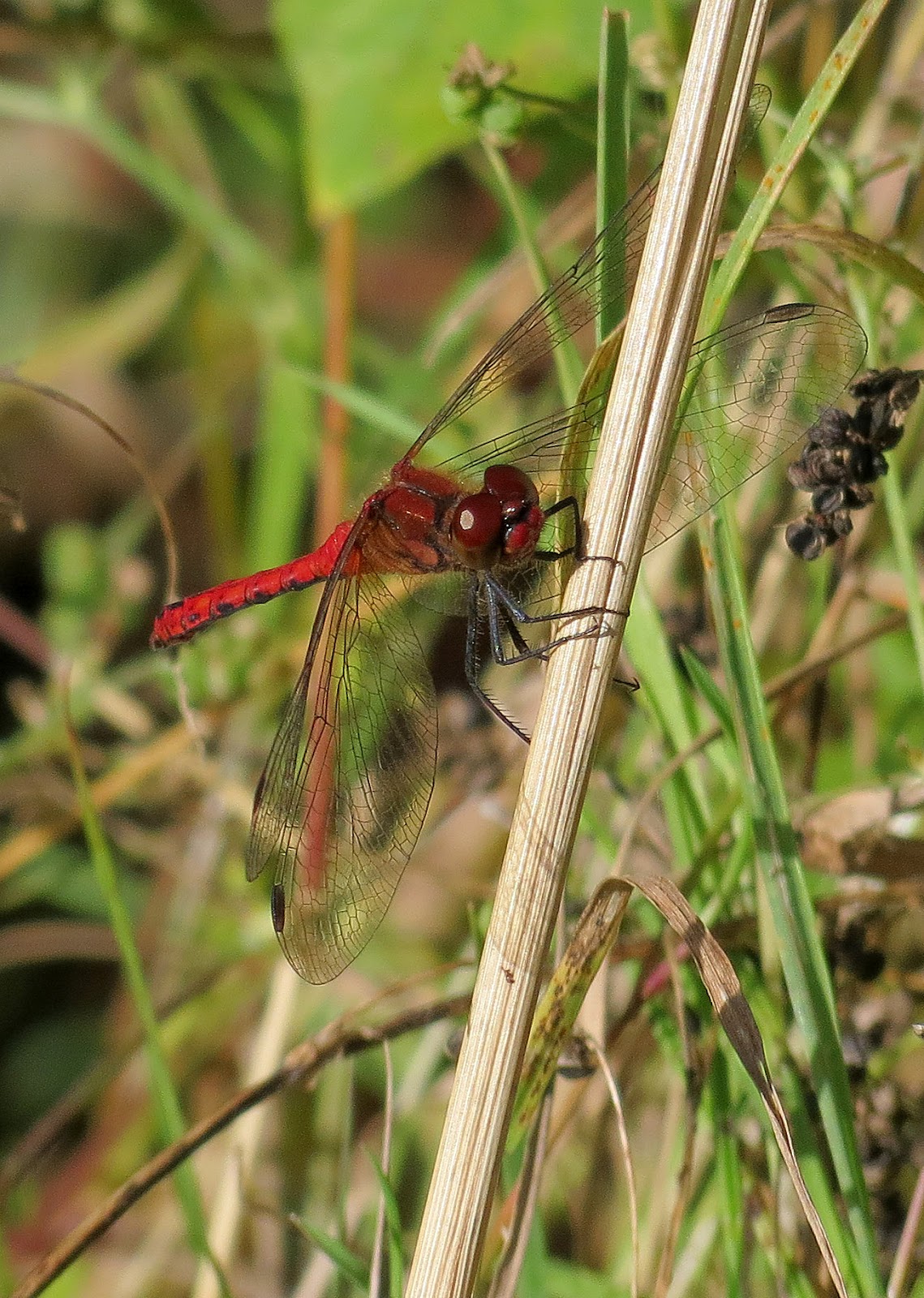
Male Ruddy Darter

Male Ruddy Darter

Male and female Migrant Hawker (the male is the blue one)

Male and female Migrant Hawker

Male Common Darter

Male Common Darter

Male and female Common Darter
There are still a few dragonflies about, most notably when the sun is shining. As I have said in previous posts the Darters will be about for a couple of months yet,they are pretty hardy and it is lack of food which will kill them rather than the cold weather. I have often seen these buzzing around on sunny days in October/November and I have even seen Migrant Hawkers on warm days in December, although this has been an exception rather than the rule.

Friday, 7 September 2012

Strike a pose


A male Ruddy Darter in the 'obelisk' position. Dragonflies adopt this pose to regulate heat in their bodies, what is known as 'postural thermoregulation' for any one who is interested! On warm, sunny days these little darters can quite often be seen posing like this.

Friday, 31 August 2012

Welsh dragon

Close to the place we were staying in Wales there was a little pond which apparently held a few different sorts of dragonflies. Over the few days that we were there I only saw one sort, the Southern Hawker and they were always in flight, never settled. I did, however mange to find a couple of empty larvae shells and on one occasion I saw what I assume is a Southern Hawker in a state of emergence.


Reminds me of Alien.

Thursday, 16 August 2012

Darters


Two quite similar darter species of dragonfly are the Common Darter and the Ruddy Darter. They are both found in good numbers at Maxey gravel pits, where the above photos were taken.

The Common Darter is in the first 4 photos, the first 2 are of a female (I think) and the other 2 are of the male. The last photo of the Common Darter shows how similar it is to the male Ruddy Darter, which is in the next photo. The Ruddy Darter is told apart by the waisted blood red abdomen and the all black legs, both features that the Common Darter doesn't have.

The flight season of these two dragonflies can last until late Autumn, even after the first frosts, it is lack of food that eventually kills these beasts rather than cold nights.

Saturday, 4 August 2012

Common Darter


Just a few shots of a female (I think) Common Darter dragonfly taken in a spell of sunshine today with a close up of the head. The compound eye of these insects always fascinates me, such an alien looking thing.

Friday, 20 July 2012

Shooting Dragons with a Canon

Still having a `play around` with the new camera! This time I was trying to get some shots of dragonflies and although the images below aren't amazing, I am fairly pleased with the results, especially the Broad-bodied Chaser and the Black-tailed Skimmer.

An immature Broad-bodied Chaser

Black-tailed Skimmer

An Emperor `ovipositing` (laying eggs) with a few damselflies in attendance

Emperor `ovipositing`
All photos taken with a Canon Powershot SX40 HS

Thursday, 12 July 2012

Black-tailed Skimmer

Another dragonfly post I am afraid. This time of year does see the `disappearance` of birds as they start their moult after the wearing business of breeding and so I am only really on the look out for insects when I go anywhere. There have been very few butterflies of any note so far this year, this may change, but I have seen a few dragonflies with the Black-tailed Skimmer being another species in good numbers at my local gravel pits at Maxey.

The photos below show the male form of this skimmer. The blue abdomen with a black tip has yellow spots along the side, the female has a yellow abdomen with two prominent longitudinal black bands on the upper surface. Males of this species can have territories of over 50metres and can be very aggressive towards other males, indeed I saw the individual pictured `chase` at least one other Black-tailed Skimmer, a couple of Four-spotted Chasers and even an Emperor! A dragonfly that is normally on the wing until early August.


Monday, 9 July 2012

Four-spotted Chasers

The most abundant dragonfly at the moment at Maxey gravel pits is the Four-spotted Chaser. They are everywhere, which is quite pleasing considering the downpours that are becoming the `norm` this summer. This rainfall must be having an affect on the wildlife, especially the insects. The number of butterflies in this country is in free-fall anyway, but this awful summer could see numbers of some species fall perilously low. Dragonflies, too must be feeling the effects of all this wet stuff!

I digress. The images below are all digiscoped as I can`t really get that close with my little hand-held camera, dragonflies are extremely wary and seem to fly at the merest hint of approach.


This species of dragonfly is widespread through most of Britain and fairly common throughout most of its range. It is found throughout Europe and there is no threat to its conservation in Britain, although where sites become over shaded the species seems to have a fall in numbers.

Their flight period lasts from late May until mid-August, with sexually active males being very aggressive and easy to see on the wing as they tend to fly and attack most things that go near them. They are seen perched on emergent vegetation and tend to return to this perch after partaking in a sortie after an intruder has entered their territory and been `seen off`.

Monday, 2 July 2012

A couple more Dragonflies

A couple more species of dragonfly that were present at Maxey gravel pits the other day were the Black-tailed Skimmer and the Hairy Dragonfly.


The photos above were taken using my Canon Powershot A640 `hand-held`

The Hairy Dragonfly is the first hawker dragonfly of the year on the wing. Males (the blue one above) are usually seen during May and early June, but I think with the lovely weather we have been having this has been delayed somewhat. The pair above were seen flying in the position you see them in, before landing in long grass, allowing me to get these hand-held shots. The duration of this copulation is variable, but can last up to 40 minutes. A dragonfly that is only on the wing for a short time, lasting from mid-May to late June or early July, so catch them while you can! They have a noticeably downy (hairy) thorax, unlike other hawker species, with the male having blue pear-shaped spots along the abdomen and the female yellow.


Both photos above were digiscoped using my normal set-up

The Black-tailed Skimmer is a fast, low-flying species, which is often observed perching on open ground or on muddy banks, stones and even roads. The species seemed to be pretty common at Maxey, with numerous individuals noted, although I only saw the yellow version of the species which is the immature male or female (I don`t know which I have photographed, any pointers would be gladly accepted). The adult male has a blue abdomen with a black tip. Another fairly common species in the southern half of the country that has a flight season lasting from late May until early August. I may get a photo or even just a glimpse of a blue  male in that time! One can hope.

Saturday, 30 June 2012

Emperor dragonfly


Every year at around this time I try to get to grips with dragonflies and every year I fail. There are only 39 resident species of this insect (with 13 migrants) to get my head around, but I just can`t seem to get the I.D. features in my thick skull.

One dragonfly that I can confidently identify though is the magnificent beast in the photos above, the Emperor. Britain`s bulkiest dragonfly, measuring a whopping 78mm, a regal insect of warm summer`s evenings that can be found in large ponds, lakes and flooded gravel pits and sometimes ditches and canals. It is widespread in southern Britain and where found is locally abundant. The site where I managed to get the above digiscoped shots is Maxey gravel pits, a site known for its breeding dragonflies as well as its birds. There are several other species of this insect present, some of which I will endeavour to photograph and identify over time.

Sunday, 20 November 2011

Dragons and Lizards

Another group of shots from my recent trip to Tenerife.

The lizards were everywhere, basking on rocks in the sun. There is a species that is endemic to the Canary Islands, the Canary Island lizard, not sure if the photos below show this species or not, some I.D. pointers would be appreciated!

Dragonflies are something that I am starting to get to grips with in the U.K. and so when I saw a few flying around I tried to get some shots. The Red-veined Darter (if I am wrong with this I.D. I would love to know) was seen around the swimming pool of our hotel and perching very conveniently poolside! The Scarlet Dragonfly was a new species to me and was seen by a lily pond on a visit to the Parque Taoro in Puerto de la Cruz. Another species een was the magnificent Emperor Dragonfly, but I was unable to get any shots of this beast!


All photos taken using my other camera Lumix FS15