Showing posts with label Common Blue (Polyommatus icarus). Show all posts

Monday, 5 August 2013

Wood Sandpiper

Talk of my demise seems to have been premature.

With reports of a couple of Wood Sandpipers being present at my local patch of Maxey gravel pits, I managed to grab a couple of hours on Sunday to go and see if I could get a view of a wader that I have not seen locally for at least a year.

This site is looking rather good at the moment and with my first scan of the area I managed to see the first Wood Sandpiper, huddled down in the company of a Common Sandpiper. Continuing my perusal of the site I picked up the second Woody, fairly close by and also 3 Dunlin, 8 Green Sandpipers, 3 Ringed Plovers, 1 Little-ringed Plover and another 2 Common Sandpipers.


On walking back to the van, it was good to note that there were fairly large numbers of Common Blue butterflies present.


Hopefully, I will be back again soon.

Monday, 3 September 2012

Blue butterflies


Two fairly 'common' blue butterflies in the Peterborough area are the Chalkhill Blue and the Common Blue. The top 3 photos show the Chalkhill (male, female, male) and the bottom 4 show the Common (female, female, male, male). These blues have a distinct difference in appearance between the sexes, with the male being the 'blue' one, while the female tends to be brown, although the Common Blue female can sometimes have more blue in the upper wing as is shown in photo 5.

This year seems to have been a good one for Chalkhill Blues with hundreds of thousands of these 'flutters' being present at individual sites. At Barnack Hills and Holes, where these photos were taken, I counted up to 450 before losing count (not thousands, but certainly good numbers). A good news story in a year when butterfly numbers have been low, to say the least.

Saturday, 30 July 2011

True blue


All taken using hand-held Canon Powershot A640

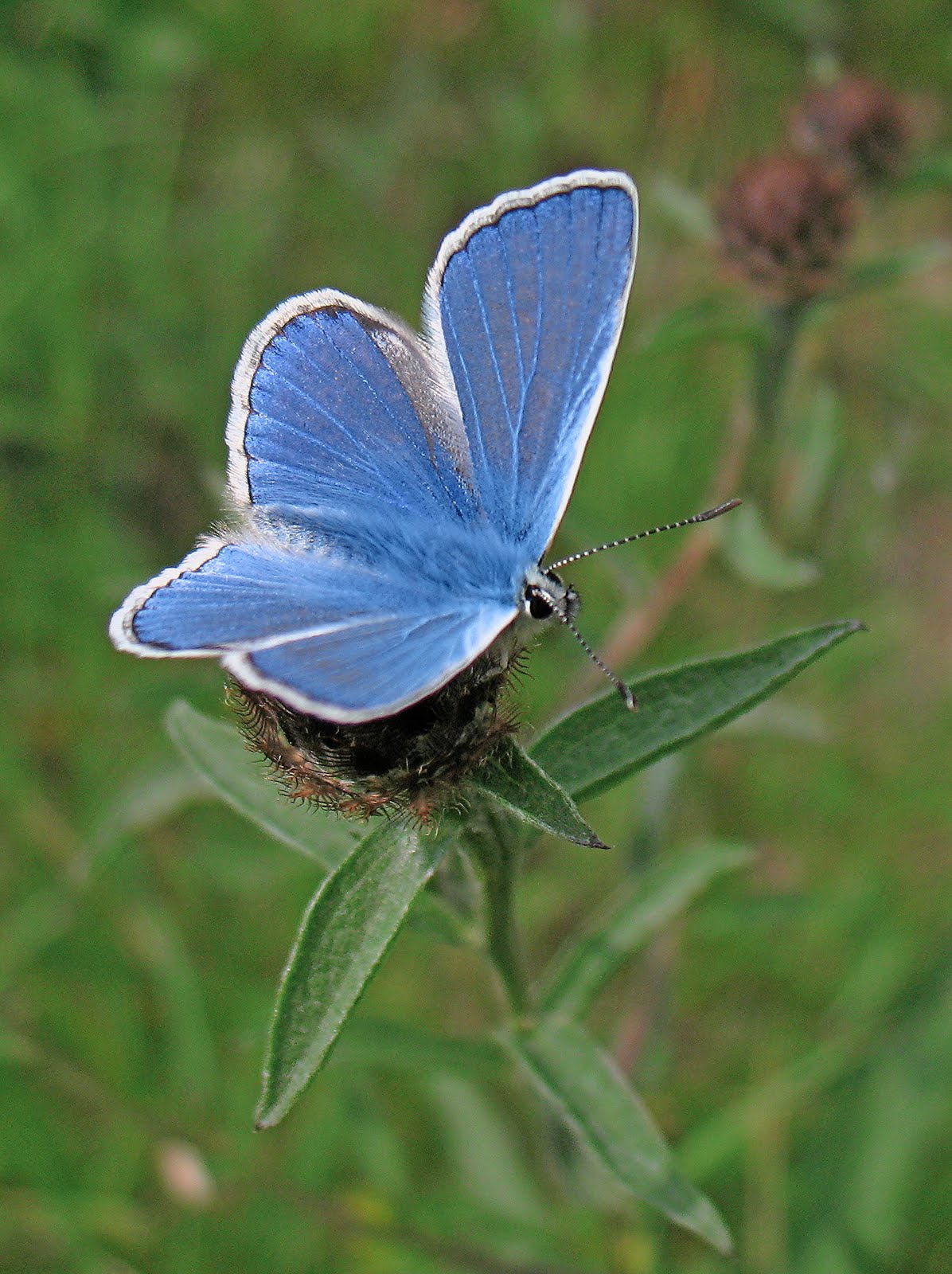
Another `Blue` butterfly, this time the Common Blue (Polyommatus icarus). This butterfly is still a regular sight in our countryside, being our most common and widespread `Blue` species. It is found from sea level to mountains throughout Britain, although is absent in Shetland. Its` success could be due it being found in a variety of habitats, including damp meadows, heaths, woodland, roadside verges, waste ground and even suburban gardens.

It is double-brooded, with the first adults flying in May and June with the second brood flying in August and September, although sometimes this becomes blurred and the butterfly can be found in July (as in this case). The male has violet blue wings, finely edged with clear white wing margins, with the female being brown, but also has the white wing fringes, although in some areas there are blue varieties of the female with the subspecies
mariscolre being particularly beautiful ( this is found in Ireland and north-west Scotland).

Wednesday, 21 July 2010

More butterflies

Having been the sort of person that was quite happy to look at a butterfly and say "what a pretty thing!", I have been slowly drawn in to actually start trying to identify the species and search for butterflies that I didn`t even know existed!

Here are some more photo`s that were taken at Bedford Purlieus on Sunday 18th July.


Common Blue


Silver-washed Fritillary


White-letter Hairstreak


Ringlet
Comma

Sunday, 18 July 2010

Bedford Purlieus

I have finally succumbed to checking out Bedford Purlieus to see the amazing array of butterflies on show there.
I don`t have a DSLR, so all the photo`s were taken with my little pocket camera. I don`t think Peter or Mike have anything to worry about on the competition front!


White-letter Hairstreak


White-letter Hairstreak


White-letter Hairstreak


White-letter Hairstreak


White Admiral (a rather tatty individual, but the only one seen)


Small White


Red Admiral


Silver-washed Fritillary


Silver-washed Fritillary


Large Skipper


Gatekeeper


Common Blue


Common Blue


Comma

As well as these there were also lots of Ringlets and Meadow Browns.