Showing posts with label Vagrant. Show all posts

Monday, 5 December 2011

Western Sandpiper

A Semipalmated Sandpiper was reported from Cley Marshes in north Norfolk on Monday of last week and I toyed with the idea of going to see it, as Norfolk is not too far and it would have been a lifer. On Thursday this bird had been re-identified as a Western Sandpiper, an extremely rare vagrant to our shores in the U.K., a MEGA if you will. A couple of conversations with my friend Chris Orders later and we had decided to `go for` this bird on Saturday morning, work delaying us both until then.

Chris picked me up at about 6.45am as we planned to get to Cley by 8.15am. The journey was uneventful and we made good time, pulling up at the car park of this reserve at 8.10am. To our surprise there were very few cars parked and so we began to think the worst, the bird had flown away in the night, but no, a member of staff appeared and informed us the bird was present and showing well. We quickly walked to the hide and entered the hush where we were very kindly put on to the bird which was quite distant, but quite easily picked out. At this time there were only 9 people present, ourselves included and so we enjoyed good scope views of this lovely little bird. The hide slowly began to fill and so we left, letting others have the views we had just enjoyed. On returning to the car park, it was a lot more full than when we arrived and more cars were arriving, we obviously chose the right time to get there!

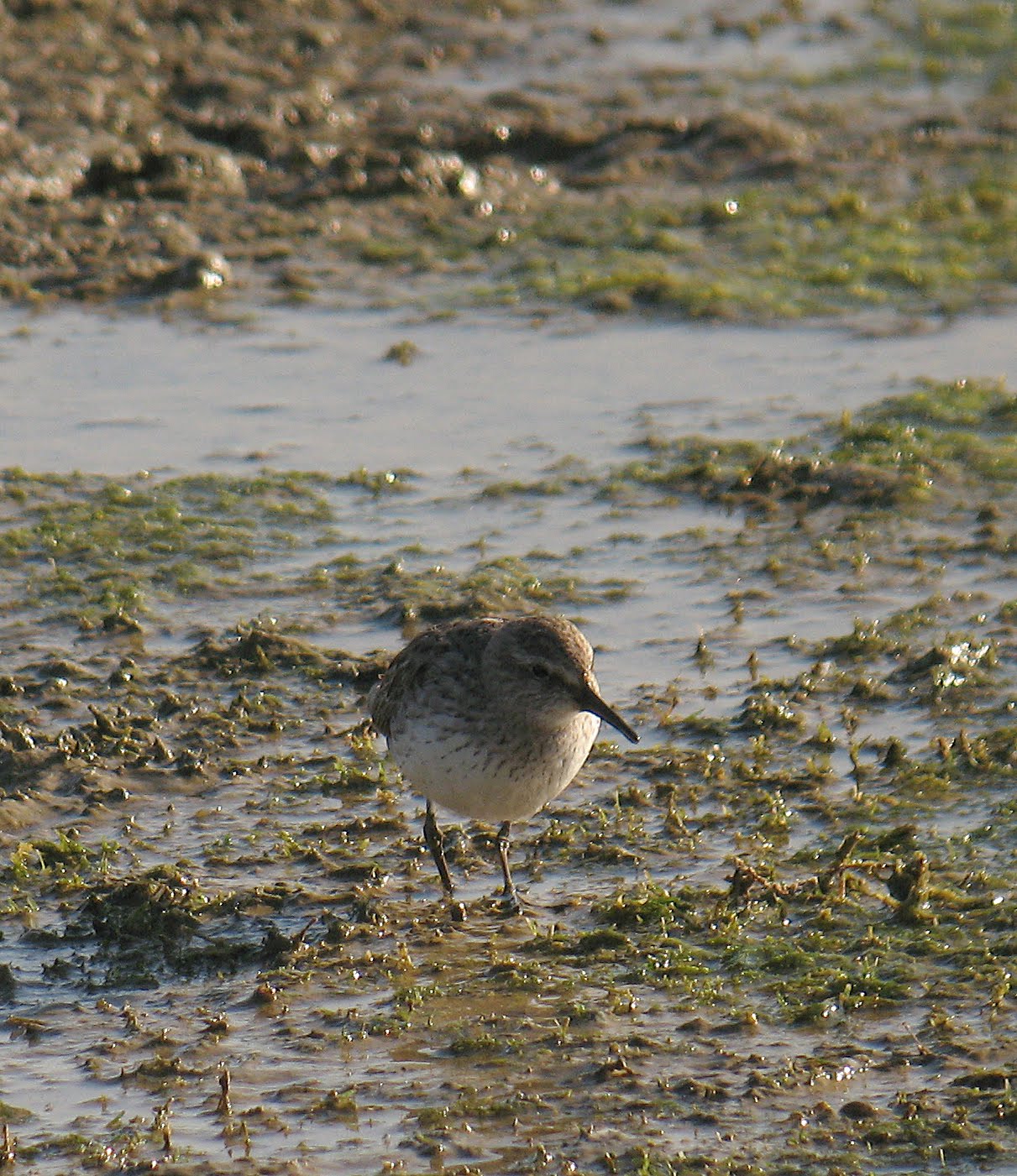
A much easier `twitch` than we both had imagined and a lifer for us both. Below are a couple of `extreme` record shots of the bird as it never really got very close, but in my minds eye I have some very good `photos`!

Thank you to Chris for driving.


I apologise for these photos as they are not what I would normally post, but the bird was something special and so I had to have some sort of record, even one as bad as this!

The Western Sandpiper is a very small north American wader, the size of a House Sparrow and this is only the 6th time that this species has been recorded on mainland Britain, the rarest of the American stints in Europe.

Whilst we were in Norfolk we also visited a couple of other sites, which will be in future posts.

Wednesday, 23 November 2011

White-rumped Sandpiper

Back on the 22nd October Lisa and I paid a visit to Rutland Water to see the lingering adult White-rumped Sandpiper. The bird had been around for a few days and I saw it as a good chance of getting this wader on my British list.

On arrival at the reserve we quickly realised that we were not going to be alone in seeing this bird as the car park was full, with the overflow car park overflowing! We eventually managed to park and after paying, started our long walk to what is the furthest hide on the reserve from the visitor centre. We passed many binocular wearing and scope carrying birders who all assured us that the bird was still showing, so we pressed on.

We arrived at the rather full hide, which conveniently is quite a massive construction and were put onto the bird straight away by a very helpful birder. The sandpiper was hanging around with a group of Dunlin, which didn`t aid me in picking out the bird. To the uninitiated (i.e. me!) the birds looked pretty similar (see the last but one photo below), but after being shown the i.d. features by the same helpful birder I managed to get my eye in and was actually able to point the bird out when new arrivals came into the hide.

The White-rumped Sandpiper breeds in North America, is a little smaller than the Dunlin and has quite a bold white eye-stripe. The wings of the bird are also quite long, in fact they project beyond the tail. Also, it has a white rump, which is obvious in flight and helpfully the bird at Rutland showed all these features off rather well.

Another tick in the book!


Sunday, 9 October 2011

Pectoral Sandpiper


A few weeks ago I put up a post showing what I mistakenly thought to be a Pectoral Sandpiper, a bird that is a regular visitor to our shores in the U.K. I was shown to be incorrect in my assumption, but this time, I am showing some rather distant record shots of a juvenile `Pec` that was present at Frampton Marsh last weekend.

The bird is the larger one of the two in the last photo and the middle sized one in the other two. The other birds digiscoped are a Ruff (the larger one) and a Little Stint (the smaller one). I suppose the photos, if nothing else, give a useful comparison to wader size and shape.

The bird had given me the run-around earlier by disappearing for an hour just before we arrived on site and despite searching we were unable to re-find it, but on returning to the visitor centre I noticed a large group of birders excitedly looking through scopes and binoculars in the area that we had just walked from, a 15 minute walk. Typical, I thought! I was not, however, going to let this bird defeat me and so, I set off to finally `bag` this American wader. On arrival, the bird was showing well, if distantly and was then joined by the other two waders in the shots, giving the useful size comparison and then flew, never to be seen again! I got there just in time!

Thursday, 6 October 2011

More LBD shots


These are the last of the photo`s of the Long-billed Dowitcher from Sunday. The bottom one gives a rough idea of the size of the bird when compared to the Oystercatcher behind.

A top bird which gave the assembled crowd a good show!

Monday, 3 October 2011

Long-billed Dowitcher


The local patch is a bit stagnant at the moment, to say the least, can`t even rustle up a Dunlin! With this in mind I decided to stretch my `birding` wings a bit further on Sunday and see if I could catch up with the Long-billed Dowitcher at Freiston Shore in Lincolnshire. This place is only 40 miles away from where I live, so not too far and an easy enough drive.


The bird was easy enough to find, with approximately 40 birders staring through a hawthorn edge, it kind of gave the game away! It was constantly feeding, its head was in the water more than not and so the photo opportunities came few and far between, but I managed a few passable shots and these are the first of several that I will eventually post (I have got quite a few that I want to put up here, but not in one go).


The Long-billed Dowitcher is a vagrant to our shores, breeding in North America and East Siberia, but there are several records every year. The bird (to my eyes) is a bit like a cross-between a Common Snipe and a Black-tailed Godwit, indeed the bird is Snipe sized, with a very long bill and fairly long greenish legs.


After a lifetime of `local` birding and only venturing out further on holidays and rare occasions, I am slowly building a longer list of seen birds as this was another `lifer` to go in the book!

Sunday, 17 July 2011

Spotted Sandpiper


Back to birding with a spot of `twitching` yesterday.

This Spotted Sandpiper has been present at Rutland Water for the past few days, but with work commitments I have been unable to visit. Rain scuppered my plans for working yesterday and so with the bird being reported early in the morning I decided to brave the weather and get this `lifer`!

After a rather long walk, in what can only be described as torrential rain, I arrived at the hide that the bird had been seen from. I entered and was kindly put on to the bird by a young lad who was watching it through his scope, I was rather less than enamoured with the view as the bird was at least 500m away! (This bird is the size of a Starling, so is rather small). However, I duly `ticked` and settled in to wait to see if the bird came any closer. The hide gradually filled, the rain got heavier and the bird stayed where it was. Eventually, it flew, but no-one saw where to, so I decided to watch the family of Ospreys that were putting on a little show, obviously annoyed at all these birders paying them no heed. Half an hour went by, the conversation in the hide started to become slightly negative to say the least and I was about to leave, happy in adding 1 more tick in my book, when on a last scan of the area I noticed the Spotted Sandpiper standing approximately 40-50 metres in front of the hide giving fantastic views! After informing everyone I watched and Digiscoped this bird for approximately 20 minutes while it fed quite happily infront of the now happier crowd. It put on a fantastic show, showing its spots off to the full and then flew to the far bank where it remained.

This little wader breeds in North America and is a fairly regular vagrant to Britain with annual records, indeed a pair attempted to breed in Scotland in 1975, but this was unsuccessful. It is related to `our` Common Sandpiper and out of its spotted finery in the winter it is very difficult to tell them apart. Luckily, this bird was all spotty and very obviously a Spotted Sandpiper.